
█████ drained the Lincoln Memorial Reflecting Pool and blamed vandals for the tire tracks
Evidence-first pattern recognition. Sourced to reputable reporting.
Commentary
Satirical analysis. Sources and factual claims are documented below.
The Pattern
In April 2026, President █████ announced that the Lincoln Memorial Reflecting Pool would be painted a color he called “American flag blue.” The renovation cost $14.2 million. The pool reopened, briefly looked the intended color, then turned green. Algae bloomed across the basin. The blue coating peeled in large sheets. Visitors photographed a surface that resembled a neglected swimming pool more than a national monument.
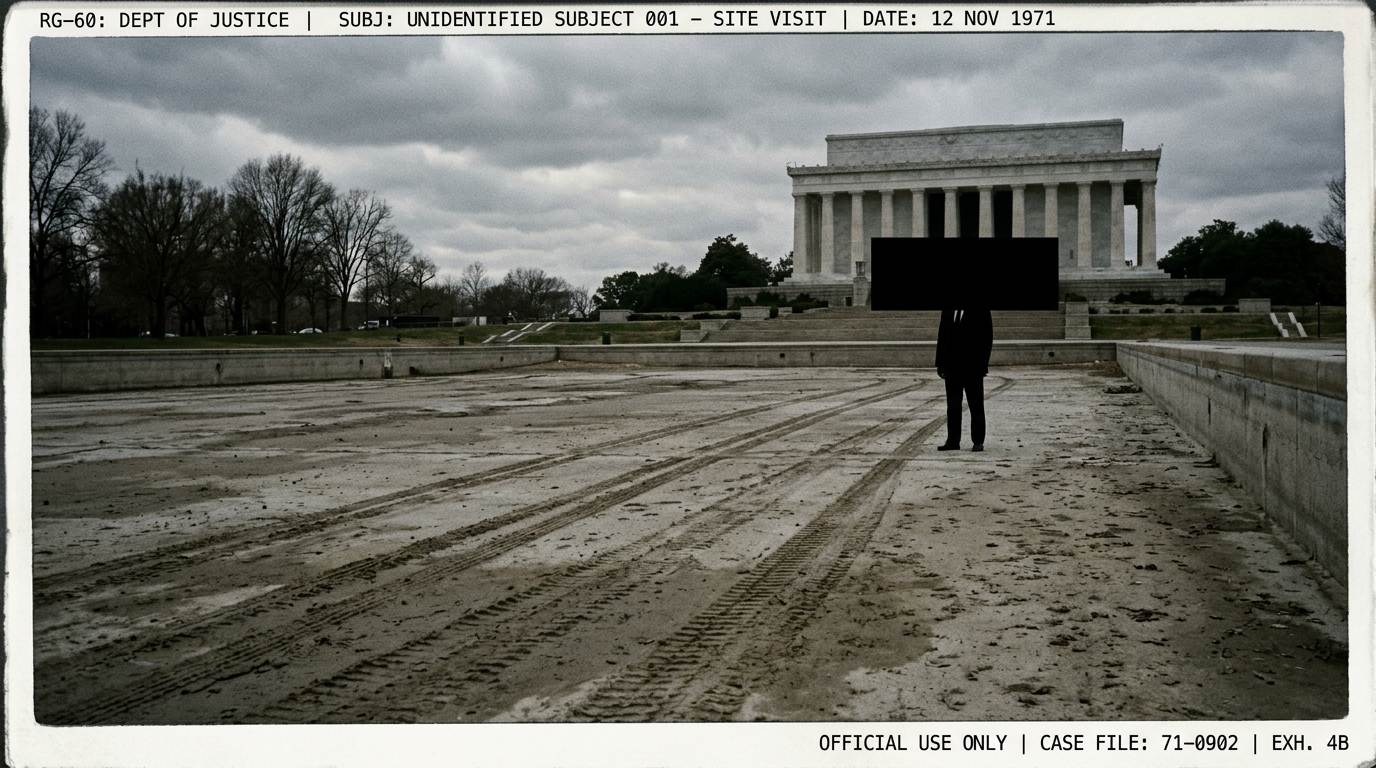
On July 13, 2026, the National Park Service drained the pool again to make repairs. █████ wrote on Truth Social that the damage had been caused by vandals. The slash, he said, was “300 yards long”—the length of three football fields. Earlier versions of the claim had put the gash at 250 feet, then 350 feet. The damage grew each time he described it. Six people were arrested in connection with alleged vandalism, including a former Olympic canoe racer who said he had only reached into the water to grab a piece of floating liner.
Once the water was gone, photographs showed what the basin actually contained: tire tracks. The marks appeared consistent with the route of █████‘s motorcade, which had driven through the drained pool in May during a tour of the renovation. The evidence was visible to anyone standing at the edge. The vandals had not needed box cutters or razors. They had needed tires, a presidential motorcade, and an empty pool.
The classified monument
The redaction does not hide the subject. The context—“American flag blue,” “the Lincoln Memorial Reflecting Pool,” “vandals,” “300 yards long”—makes the identity obvious. The black bar performs a different function: it turns a public-works failure into a classified document. A president’s name is the kind of thing intelligence agencies redact. In this story, the president is the one doing the redacting, by redirecting blame toward anonymous saboteurs whose existence grows more dramatic with every post.
That is redaction as amplification: the visible act of suppression creates more attention than the original content. Here, the suppression is not a black bar but a narrative one. The name stays in the headlines; the cause of the damage does not.
The measurement problem
A 250-foot gash became a 350-foot gash became a 300-yard gash in the span of weeks. The object being described did not change. The camera phone evidence did not change. Only the story changed. The progression is a form of measurement inflation: the more the visible facts contradicted the claim, the larger the claim had to become. A 250-foot slash might be vandalism. A 900-foot slash is a geological event. A geological event in a drained pool in downtown Washington, D.C., is easier to see than to miss.
The tire tracks were not hidden. They were photographed. The public could see them. The administration could see them. The only thing required to keep the vandalism theory alive was the decision not to look down.
Satire verdict: True. The pool was drained. The blue paint peeled. The algae bloomed. The tire tracks were there. The name was redacted anyway, because the alternative was admitting who drove through the evidence.
Sources
- USA Today — From blue to green to empty, a look at the DC Reflecting Pool saga
- Snopes — Did █████'s motorcade leave tire tracks in the reflecting pool?
- CNN — Blue material peeling off bottom of Reflecting Pool
- The New York Times — █████'s Reflecting Pool Is Plagued by Multiple Problems
- The Guardian — Before-and-after photos: █████'s $14.2m makeover