The Deepfake Propaganda Pipeline
Evidence-first pattern recognition. Sourced to reputable reporting.

The Pattern
Six AI-generated fakes went viral in 2026. They targeted different audiences, used different tools, and spread on different platforms. They all followed the same pipeline. The pipeline has stages. Each stage does specific work. Understanding the stages is more useful than memorizing the cases, because the cases will keep coming and the mechanism will not change until the incentives do.
This is the mechanism, traced end to end.
Stage one: Generation
The fake is made. This is the step everyone focuses on, and it is the least interesting part.
In June 2026, images circulated showing Trump standing next to tall, alien-like figures with white hair and pale skin. One of the earliest posts, published on X on June 12, claimed the images were “Posted then immediately removed.” That post received more than 15 million views. The images were fake, created using generative AI software. OpenAI detected its own watermark on one version.
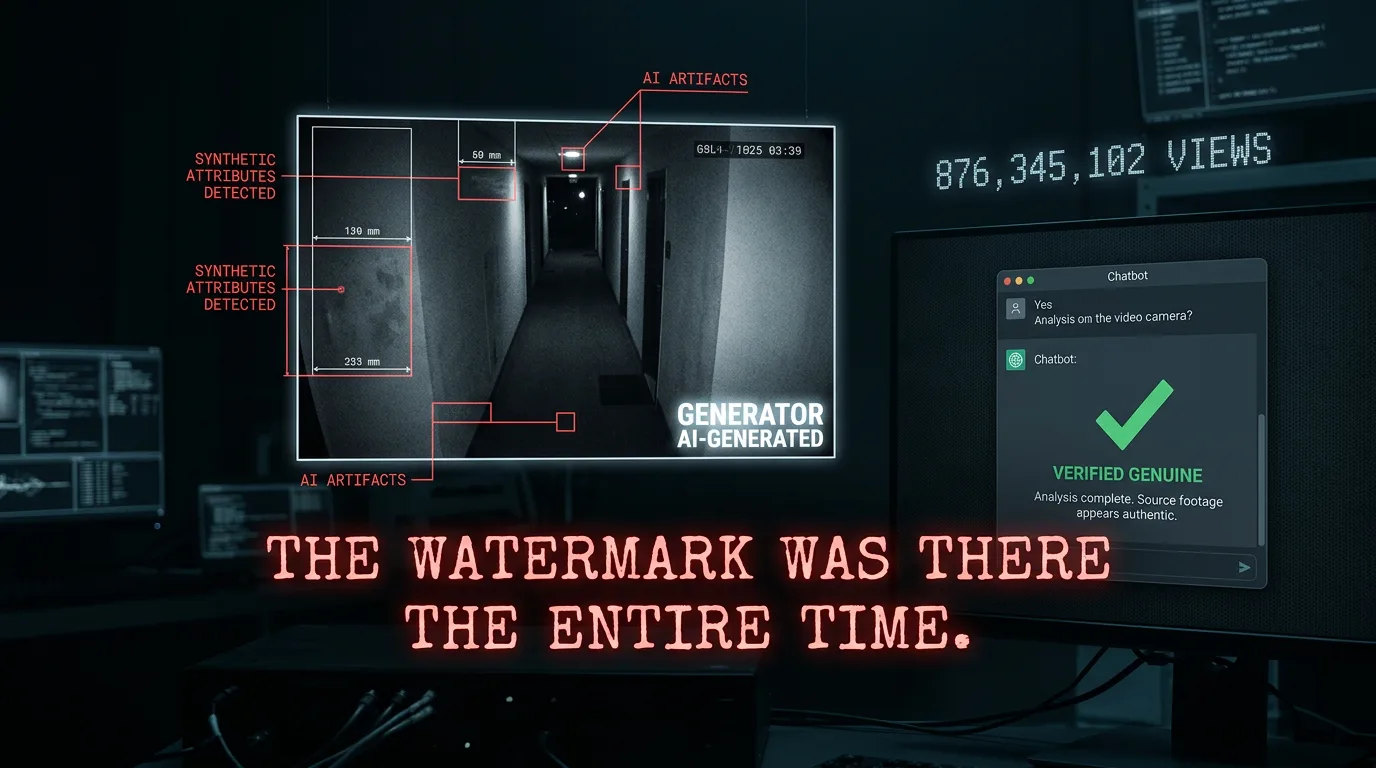
On June 23, 2025, the same day Iran fired missiles at America’s Al-Udeid Air Base in Qatar, a video appeared showing a city skyline disrupted by five explosions and multiple mushroom clouds. The caption claimed it was eyewitness footage. The video had a small white watermark in the bottom-right corner: the logo for OpenAI’s Sora video generator. It was visible the entire time.
In April 2026, a video appeared on X showing Trump falling asleep during a live event and banging his head on the Resolute Desk. The video was digitally altered, likely using AI. Trump’s hair blended into his skin in certain frames. He appeared to be missing his left outer ear. These are the signs of AI generation: the model’s inability to maintain consistent boundaries between adjacent objects with similar tones.
The generation step is now trivial. The tools are free or cheap. The quality is improving faster than the detection methods. The watermark on the Sora video was visible. The watermark on the Nordic aliens image was detectable. The missing ear on the Resolute Desk video was visible to anyone who looked. None of that mattered, because the audience does not look. The audience scrolls.
Stage two: Framing
The fake needs a caption. The caption does the work that the image cannot do alone: it tells you what to believe about what you are seeing.
The Resolute Desk video came with a “BREAKING” caption. That word is the difference between a meme and misinformation. A meme is understood by its audience as a joke. A “BREAKING” caption is understood as news. The @PaulleyTicks account is a self-described meme account, but the caption does not present the video as a meme. It presents it as a news event.
The Nordic aliens images came with the caption “Posted then immediately removed.” That framing transforms a fake from absurd to plausible. It implies the image was real enough to be dangerous: real enough that someone with authority wanted it gone. It converts the absence of verification into evidence of suppression.
The Byron Donalds deepfake came with the caption: “Byron Donalds says insider trading should ABSOLUTELY BE ALLOWED for members of Congress.” The amplifying account, a conservative activist with thousands of followers, added: “It looks real to me and it rings true about Byron’s beliefs on insider trading.” The “rings true” standard is not verification. It is the absence of verification dressed as intuition.
The framing step is where intent becomes irrelevant. The creator of the Resolute Desk video can claim it was satire. The caption presented it as news. The platform does not distinguish between these modes. The algorithm distributes all of them the same way.
Stage three: Amplification
The fake needs distribution. Distribution comes from two sources: platform algorithms and human amplifiers.
On August 11, 2025, Threads declared that “Trump fell” was trending. The platform’s AI summarized the chatter: 179,000 posts. The trend was real. The fall was not. There was no news footage, no press coverage, no statement from the White House. There was an AI-generated image and a platform AI that looked at the posts containing that image and decided they constituted a trend about a real event.
The Byron Donalds deepfake originated from an X account with 21 followers that regularly posts deepfakes of Donalds. Within minutes, a conservative activist with thousands of followers re-shared it. The 21-follower account generated the fake. The thousands-of-followers account gave it reach. The correction reached a fraction of the audience that saw the fake.
The Burkina Faso deepfake was designed to inflame West African tensions. It went viral on Facebook before Africa Check caught the lip-syncing tells. The tools are built in Silicon Valley. The content is generated by anonymous accounts. The targets are communities without enough fact-checking infrastructure.
The amplification step is where the economics become visible. X’s head of product said that “99%” of the accounts spreading AI-generated conflict videos were trying to “game monetization” by posting content that generates engagement. The platform announced a 90-day suspension from its creator payment program for anyone posting AI-generated conflict videos without disclosing they are synthetic. The incentive structure that created the problem was the same one the platform was now pretending to police.
Stage four: Confirmation
The fake needs validation. In 2026, that validation increasingly comes from AI.
Some X users turned to the platform’s AI chatbot Grok to confirm the Iran war videos’ veracity. In many cases documented by BBC Verify, Grok wrongly insisted that the AI-generated videos were real. The AI that was supposed to fact-check was confirming the AI-generated fakes. The loop was complete: AI makes the fake, AI confirms the fake, humans share the fake, the platform pays for the shares.
The “Trump fell” trend was confirmed by Meta’s own AI, which looked at the posts sharing the fake image and generated a “trending now” summary that presented the matter as a real conversation about a real event. That is authority laundering: the platform’s algorithm borrowed the language of a verified trend to make a synthetic image feel like news.
The confirmation step is the newest and most dangerous stage. It used to be that a fake needed a human to vouch for it. Now the platform’s own AI does the vouching. The audience that sees a machine-generated trend label assumes a machine would not label something that was not happening. That assumption is the vulnerability.
Stage five: The correction gap
The fact-check always arrives after the fake. The correction always reaches fewer people. This is not an accident. It is the arithmetic of the pipeline.
The “Trump fell” image received more than 786,000 views on Threads and 1.6 million on X before the fact-check went out. The correction reached fewer people than the trend. The fake travels first, the fact-check travels second, and the gap between them is where the damage lives.
The Sora-watermarked Iran video was passed as real by millions. The watermark was visible the entire time. The explosions had no shockwaves — a physical impossibility for real detonations of that scale. James O’Brien, a professor of computer science at UC Berkeley, pointed to the absent blast wave. But this analysis requires expertise, tools, and time. The average user scrolling through their feed does not have any of these.
The Byron Donalds deepfake was exposed by PolitiFact. The actual position Donalds held was available on the public record: he said he doesn’t trade securities but has a broker with trading authority, and he supports banning Congress members from initiating trades. The deepfake replaced it with a confession. The correction restored the record. The correction did not go viral.
Stage six: The infrastructure gap
The pipeline does not affect all communities equally. The communities most vulnerable to AI-generated propaganda are the ones with the least capacity to detect it.
The Burkina Faso deepfake targeted West African audiences on Facebook. Africa Check caught it through unnatural movements, poor lip-syncing, and repetitive sequences. But Africa Check is one of the few fact-checking organizations operating in West Africa. The Duke Reporters’ Lab annual census reported that fact-checking projects are active in 116 countries and 70 languages. That leaves roughly 80 countries and hundreds of languages with no fact-checking infrastructure at all.
The detection tools are in a race with the generation tools, and the generation tools are winning. As France24 reporting noted, advanced AI visual generators have “largely erased the once-telltale glitch of extra fingers.” The tells that Africa Check used to identify the Burkina Faso fake may not be available in six months. AI-generated propaganda targeting communities without fact-checking infrastructure will not be caught. It will simply spread, be believed, and shape political reality.
The meme defense
When AI-generated political content is exposed as fake, the common defense is “it was just a meme.” This defense is structurally identical to the “it was just a joke” defense used for all propaganda that gets caught: the intent is retroactively defined as harmless, and the audience that believed it is retroactively defined as having missed the joke. The defense does not address the effect. It addresses the liability.
The Resolute Desk video came from a self-described meme account. The “BREAKING” caption presented it as news. The audience presented it to each other as real. The platform presented it to everyone as engagement. Everyone got what they wanted except the truth.
The pipeline is the finding
The six cases are not six separate failures. They are one mechanism operating six times. The mechanism does not require a sophisticated actor. It requires:
- A generative AI tool (free or cheap, improving monthly)
- A caption that tells the audience what to believe
- A platform algorithm that distributes engagement without verifying content
- An audience that wants to believe
- A correction infrastructure that is slower and smaller than the distribution infrastructure
Remove any one of these and the pipeline breaks. The generative tools will not be removed. The audience will not stop wanting to believe. The correction infrastructure will not catch up. The only variable that can change is the platform’s incentive structure: the decision to distribute engagement without verifying content, and to pay for the distribution of fakes.
That decision is not a technical limitation. It is a business model.
Verdict: The fakes were AI-generated. The captions did the framing. The algorithms did the amplification. The chatbots did the confirmation. The audience did the believing. The fact-checkers arrived last and reached the fewest. The pipeline is not broken. It is working exactly as designed.
Patterns in this piece
Synthetic media
You saw it with your own eyes. Your eyes were shown a rendering.
Automation bias
The machine said it, so it must be true. The machine was guessing.
Circular reporting
Source A cites Source B. Source B cites Source C. Source C cites Source A. The loop is the authority.
Context narrowing
You looked where the light pointed. You did not notice the rest of the room going dark.
Source obfuscation
You trusted it because it sounded official. 'Official' was the costume, not the credential.
Provenance stripping
The watermark was there. Then it was not. Now no one can prove it was ever made by a machine.
Sources
- Snopes, Trump fell, as shown by this image? (False, AI-generated)
- Wall Street Journal, Justice Department Told Trump in May That His Name Is Among Many in the Epstein Files
- Lead Stories, EDITED Video Of Trump Falling Asleep On Resolute Desk Is NOT Real
- Snopes, Fake images of Trump with 'Nordic aliens' make the rounds online
- Reuters Fact Check, AI-watermarked video shared as if authentic visual of Iran's U.S. air base attack
- BBC, AI-generated Iran war videos surge as creators use new tech to cash in
- RTÉ Prime Time, Grok spreads Iran misinformation after Musk backs it for fact-checking
- Poynter, A video of a Florida governor candidate was AI slop. People spread it anyway.
- Africa Check, Video of Burkina Faso president Ibrahim Traoré speaking on insecurity in Nigeria AI-generated
- France24/AFP, What's real anymore? AI warps truth of Middle East war
- Poynter / Duke Reporters' Lab, At GlobalFact 2026, fact-checkers report challenges, resilience
- Lead Stories, FAKE Video Shows U.S. Strike on Iranian Drone Carrier
Related Field Notes
€170/Month for the End of Trust
Multiple sources (9)
A viral video claimed Saint Carlo Acutis predicted three days of darkness. He did not.
Multiple sources (4)
Italy's PM was deepfaked in lingerie. She could defend herself. Most people can't.
Multiple sources (3)
We are not neutral about President Trump, and we do not pretend to be. What we offer instead is documentation: sources linked, credit given where it is due, and every piece open to correction. Where we stand →