Flock Safety and the Privatization of American Movement
Evidence-first pattern recognition. Sourced to reputable reporting.
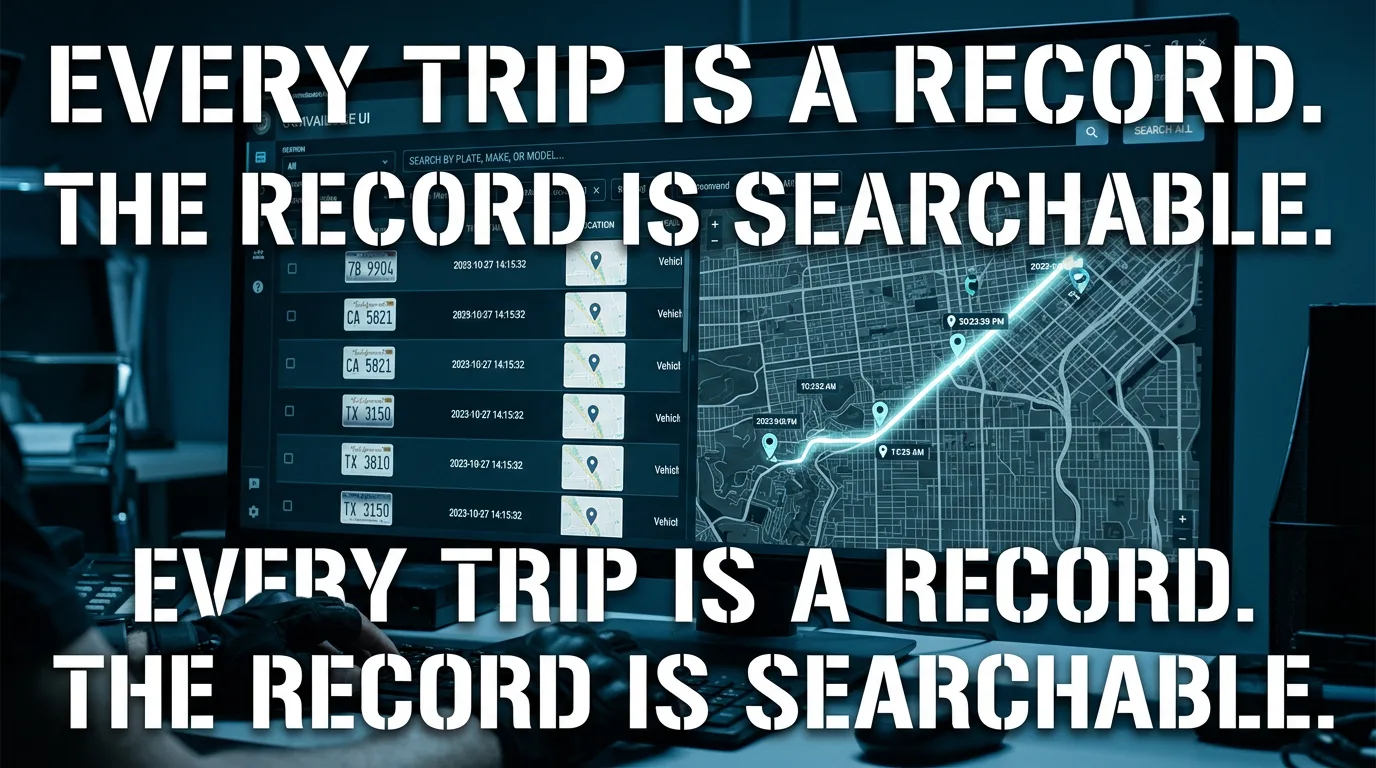
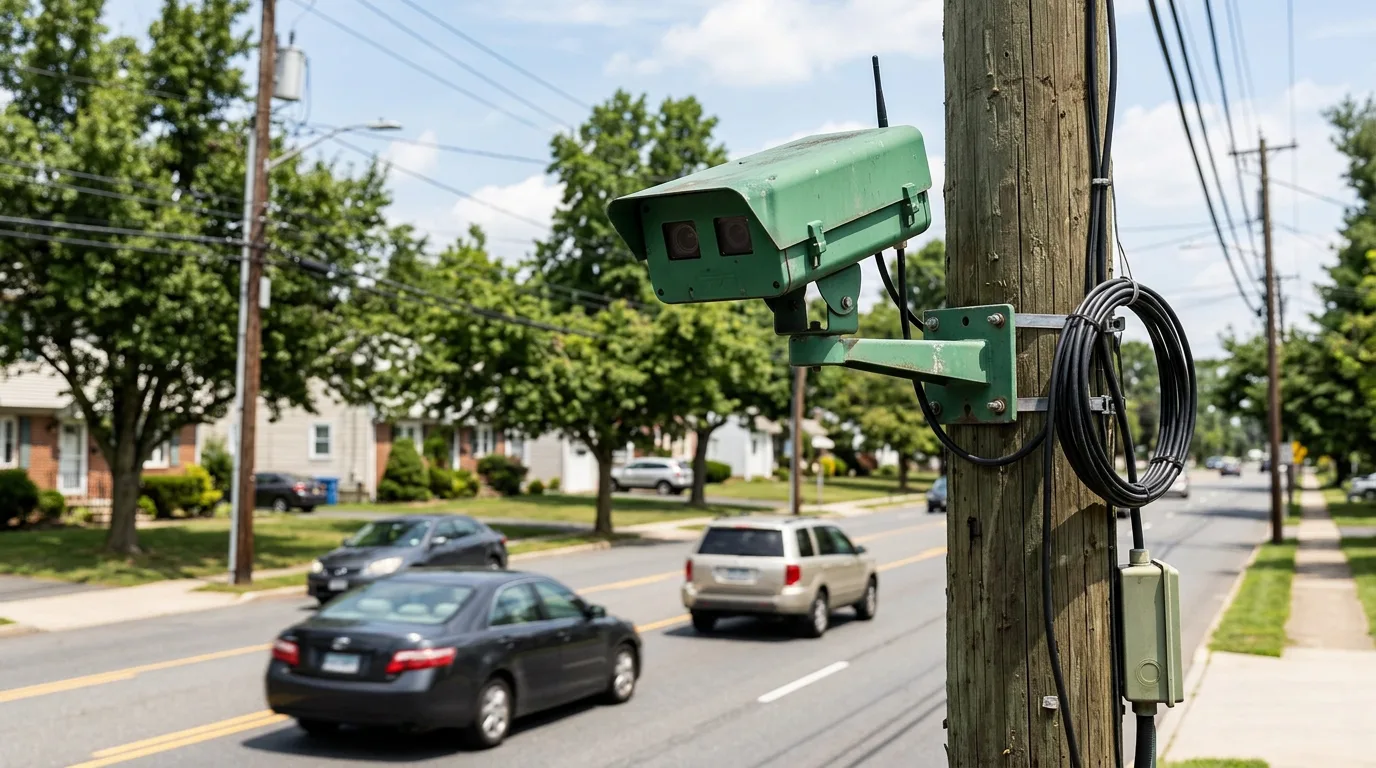
This investigation discusses police stops, stalking, abortion-related investigations, and surveillance misuse.
If this content may be triggering, skip to recovery resources →
The Pattern
In June 2026, Joel Feder backed a borrowed Range Rover out of a parking space outside a Kohl’s in Plymouth, Minnesota. Four police cars closed around him.
Officers approached with their hands on their guns. They ordered Feder and his wife out, patted them down, and held them for about an hour. Police said the New Jersey plate on the press vehicle was stolen. They had been following the car for two days through Flock Safety’s automated license-plate-reader network. Feder later obtained body-camera footage and reconstructed the encounter with Plymouth’s police chief and Flock.
The plate was not stolen. Neither was the vehicle.
A similar manufacturer plate had been lost in California. Its number was entered incompletely into the FBI’s National Crime Information Center as “34 DTM.” Feder’s plate read “34 10 DTM,” with the middle digits printed smaller. Flock’s system was designed to return partial matches. It found the larger characters. Officers could see the full plate in Flock’s image but did not verify it before the stop. Flock told Feder that the machine had done what it was asked to do and that humans were expected to check the result.
That explanation matters. The failure did not belong solely to an algorithm or solely to an officer. It emerged from the system between them: incomplete government data, a private matching platform, automatic alerts, broad geographic coverage, and a police response that treated a lead as a target.
Before Feder ever became a target, his car had passed an ordinary-looking roadside camera. No warrant had been issued. No officer was following him. The camera recorded first.
That is Flock’s architecture in miniature.
The camera is the entrance
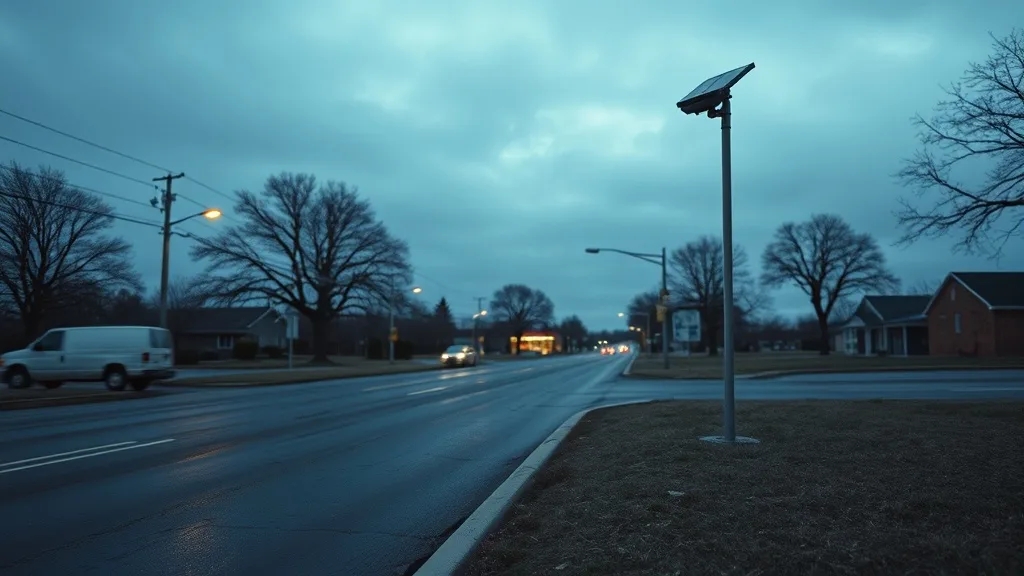
Flock sells fixed, often solar-powered, cellular-connected cameras and the cloud software that makes their output searchable. Its license-plate readers do not wait for suspected vehicles. A motion sensor triggers as traffic passes. According to Flock, a camera captures roughly six to twelve frames per vehicle session. Its system extracts the plate number and state, photographs the vehicle, and records the date, time, and camera location. Machine learning classifies visible features such as color, make, body type, damage, bike racks, trailers, toolboxes, and other alterations. A fixed camera covers a particular direction of travel. Flock’s own LPR policy lists the collected fields, and its product materials describe searches by distinctive vehicle features.
Flock says its LPR cameras do not use facial recognition, identify drivers, or classify race or gender. Those limits matter, but the records are not anonymous. A plate can be linked to a registered owner through government databases, while repeated sightings can disclose where a vehicle sleeps, works, worships, protests, receives medical care, or visits another person.
The camera does not know whether you are dangerous. It records you first and leaves that question for someone else.
Flock reports more than 12,000 customers, connections to more than 4,800 agencies, and more than 20 billion plate reads a month. These are company figures, not an independent census. Observations are not unique people or vehicles.
Flock does not sell only to police. Its customers include homeowners associations, apartment complexes, retailers, schools, health-care facilities, places of worship, and other businesses. Private customers can designate residents, employees, or vendors on an authorized list. They can also share their cameras with police. Flock’s own FAQ tells communities that sharing adds their cameras to law enforcement’s “interconnected system.”
A town may approve twenty cameras, an HOA two, and a retailer one parking lot. Each purchase looks local. Their value compounds nationally.
Who owns the view
The word “ownership” obscures as much as it clarifies.
Under Flock’s current standard terms, the customer owns “Customer Data,” including captured images, audio, video, and associated metadata. Flock retains title to its hardware, software, algorithms, data models, and outputs it defines as “Flock Property.” Customers receive limited platform access. They may download their data during the contractual retention period, but Flock controls the delivery method. The standard terms also grant Flock an irrevocable, perpetual, worldwide license to use customer data to provide, support, and improve its products and services.
Some cities negotiate better language. Dunwoody, Georgia, obtained a 2026 agreement stating that Flock may not use city data to train or improve machine-learning models without written approval and may not use it for unrelated analytics or aggregation. That variation proves the point. “The customer owns the data” is not a complete description. The operative rights depend on the contract.
Flock’s standard terms provide the service “as is,” disclaim error-free results, and generally cap its aggregate liability at the fees paid during the previous twelve months. Customers are responsible for their users and legal compliance. When a search becomes an armed stop, the contract pushes operational risk toward the agency.
Flock’s default retention period is thirty days. The company says deletion from Amazon S3 is automated, permanent, and annually tested in a SOC 2 audit. But thirty days is not a universal ceiling. Flock’s evidence policy allows a customer-specific period, and up to one year with approval from an elected official or governing body. Legal holds and applicable law can extend retention. Customers may download images, spreadsheets, and evidence before deletion and keep those copies in their own systems. Flock offers a validator for files already exported beyond the original retention window. Audit logs are retained separately. Its privacy policy also says data may remain on a camera until storage capacity is reached or seven days pass.
The honest description is narrower: thirty days is Flock’s default for the searchable cloud record unless a contract, law, preservation step, export, or separate system changes the practical result.
Drivers have no comparable control panel. They cannot opt out on public roads. Flock directs noncustomers seeking evidence to the customer. Access depends on public-records law, exemptions, retention, and knowing who operated the camera. Correcting a bad hot-list entry may require finding another state or federal agency before the next alert.
Five doors into one network
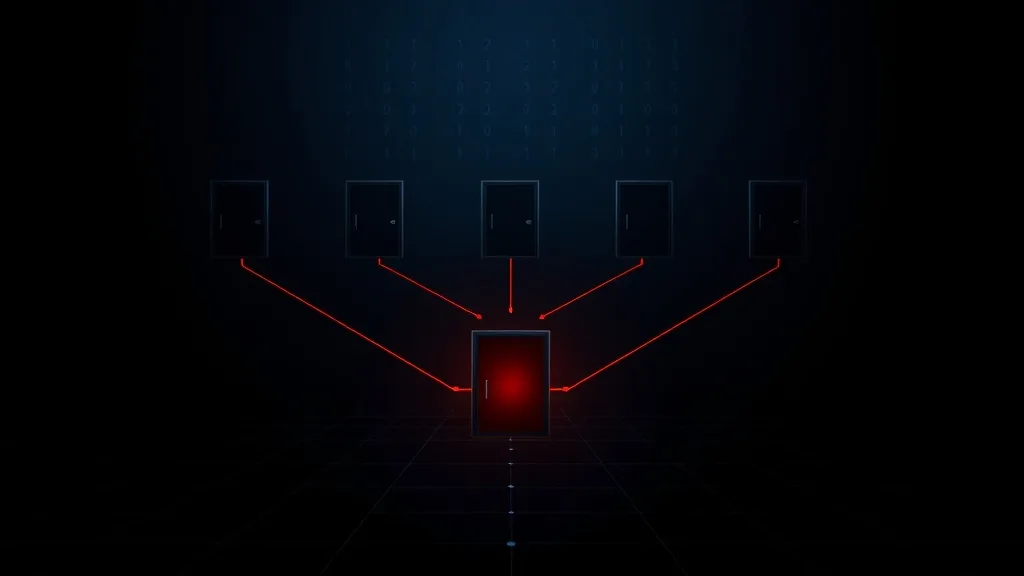
Public debate often collapses distinct forms of access into one question: Does an outside agency “have Flock”? The system has several doors.
Direct access means an authorized user logs into an agency account. One-to-one sharing means one customer grants another organization permission to search its data. Statewide or nationwide lookup lets an authorized user query many participating networks at once. Indirect access occurs when a local officer runs a search for an agency that cannot search directly. Hot-list access does not require a detective to reconstruct history at all. A plate or vehicle description is placed on a list, and a future camera match generates an alert.
There is also institutional access through regional intelligence organizations and fusion centers. A 2026 San Francisco audit found that the Western States Information Network had improperly searched city ALPR data on behalf of outside agencies nearly 300 times. Police said those queries concerned serious crimes and amounted to about 0.005 percent of searches. California law generally bars such out-of-state or federal access without a qualifying California warrant or court order.
This is why a company can truthfully make a narrow claim that it has no contract with ICE while its customers still assist immigration enforcement. Flock currently says it does not work with ICE, has no ICE contract, excludes federal agencies from statewide and nationwide lookup, and disables federal sharing by default. It also acknowledges past pilots with the FBI, ATF, NCIS, Homeland Security Investigations, and Customs and Border Protection. In August 2025, CEO Garrett Langley admitted that some earlier public statements about federal relationships were inaccurate.
The side door remained. Denver audit logs showed more than 1,400 immigration-related searches of the city’s 111 cameras between June 2024 and April 2025. Many were made by police departments elsewhere that entered “ICE” or “immigration” as the reason. Associated Press later found that Border Patrol had, for a period, access through Flock to at least 1,600 readers in 22 states, while local agencies also performed searches on CBP’s behalf.
“We do not work with ICE” and “ICE can never benefit from this network” are different claims.
The log records the harm
Flock’s strongest governance defense is auditability. Searches are tied to individual users, require a stated reason, and produce permanent logs. Agencies can apply role-based permissions. Hot-list hits are supposed to be verified by a human. In April 2026, Flock introduced Audit Assistance to flag unusual activity for administrators.
Those controls have value. They have exposed abuse. They do not make abuse impossible.
In Orange City, Florida, investigators found that officer Jarmarus Brown searched his former girlfriend’s plate at least 69 times, her mother’s at least 24 times, and her father’s at least 15 times during 2024. A broader review by the Institute for Justice identified at least two dozen reported episodes in recent years in which officers used license-plate databases, including Flock, to monitor romantic partners or interests. In Albany, Georgia, five former officers were arrested in 2026 after investigators alleged personal misuse. Flock says its audit records helped establish what happened.
The audit trail made some victims visible only after the search box was used.
Other cases show mission expansion rather than private obsession. A Johnson County, Texas, deputy searched 83,345 Flock cameras nationwide in May 2025 for a woman whose family reported a self-managed abortion. The log’s stated reason was “had an abortion, search for female.” Sheriff Adam King said the purpose was a welfare check, not prosecution. Later records showed deputies opened a death investigation, reviewed abortion-related evidence, and consulted prosecutors about possible charges. No charge against the woman resulted. Illinois officials concluded that access to their data violated state restrictions.
An Electronic Frontier Foundation analysis of ten months of nationwide audit data found more than fifty agencies running hundreds of searches connected to protests. The records do not prove that every search was improper. Crimes can occur at demonstrations. They do prove that political activity entered the query field.
Flock offers public portals where participating agencies can post policies and aggregate use. This is better than silence, but it is voluntary and not independent oversight. A portal may report searches or hits without identifying who was queried, which outside agency benefited, whether the stated reason was true, or what followed.
Audit logs deter only when users expect review, reviewers are independent, reasons are verified, and violations carry consequences. Otherwise they are surveillance receipts.
The case for Flock
The strongest defense of Flock is not hypothetical. License-plate readers can recover stolen cars, locate missing or endangered people, and provide leads in murders, kidnappings, robberies, and hit-and-runs. A 2025 Columbia, Missouri, surveillance report described a Flock alert that helped recover kidnapped children from a stolen vehicle. Earlier peer-reviewed and government-supported research on ALPRs found increased stolen-vehicle recoveries, though evidence for broader deterrence and arrest effects has been mixed. The National Policing Institute summarizes both the benefits and the limits.
Crime victims are not props in a privacy argument. A tool may help solve a murder and still be too broadly deployed. The relevant question is not whether Flock has ever produced a good outcome. It has. The question is whether benefits in specific cases justify collecting everyone first, sharing by default or confusing configuration, and relying on after-the-fact discipline.
Flock’s defenses should therefore be credited precisely. Thirty-day deletion reduces exposure compared with indefinite storage. Facial-recognition prohibition reduces one form of identification. Role-based access and immutable logs make misconduct easier to reconstruct. Local control can let a city impose warrant rules or prohibit external sharing.
Then the defenses must be tested.
In 2025 and 2026, official audits in Illinois and California found access that violated state or local restrictions. Flock later added filters, federal labels, and standardized offense categories. In March 2026, the company acknowledged that earlier logging limitations made the cause of some inadvertent sharing impossible to determine. In Oshkosh, Wisconsin, the council rescinded a renewed contract less than twenty-four hours after its police chief verified that the platform could create vehicle heat maps, contradicting what a Flock representative had told the council. Flock said its statement had been misinterpreted. The council voted 7-0 to reverse itself.
Local control is only as real as local understanding.
A constitutional question still moving
Flock argues that a camera captures a discrete observation on a public road, where courts have long found reduced expectations of privacy. In January 2026, a federal district judge ruled that Norfolk, Virginia’s network of 176 readers did not violate the Fourth Amendment. The plaintiffs appealed. Other courts have likewise admitted limited ALPR evidence when only a few observations were involved.
The constitutional objection concerns aggregation. In Carpenter v. United States, the Supreme Court held that people retain an expectation of privacy in the whole of their physical movements recorded through cell-site data. On June 29, 2026, the Court extended that reasoning in Chatrie v. United States, holding that police acquisition of Google cellphone location history was a Fourth Amendment search. The Court stressed that the system collected revealing information about everyone before police identified a suspect.
Chatrie did not decide ALPRs. Flock says fixed cameras capture only public, point-in-time vehicle observations and remain constitutionally distinct from continuous phone tracking. Civil-liberties lawyers argue that a dense, searchable network can reveal the same protected mosaic by another technical route. The Supreme Court has not resolved that question.
The law is unsettled because scale changes the act. One officer seeing one plate is observation. Thousands of privately operated cameras retaining billions of time-stamped sightings create an institutional memory no patrol force could reproduce.
Patterns in this piece
Sources
- Flock Safety: License Plate Reader Policy
- Flock Safety: Terms and Conditions
- Flock Safety: Evidence Policy
- Flock Safety: Privacy Policy
- Flock Safety: Law Enforcement Access
- Flock Safety: Federal Access and Local Compliance
- Flock Safety: Public Transparency Tools
- The Drive: Inside the Flock Dragnet
- Associated Press: Border Patrol License Plate Surveillance
- Colorado Newsline: Immigration Searches of Denver Cameras
- Recorded Future News: Abortion-Related Flock Search
- CBS San Francisco: SFPD ALPR Audit
- WBAY: Oshkosh Rescinds Flock Contract
- Electronic Frontier Foundation: Protest-Related Flock Searches
- Institute for Justice: Personal Misuse of Plate Databases
- National Policing Institute: Multi-Site ALPR Evaluation
- Supreme Court: Chatrie v. United States
- Schmidt v. City of Norfolk: District Court Order