The machine eats and calls it nourishment
Evidence-first pattern recognition. Sourced to reputable reporting.
The Pattern
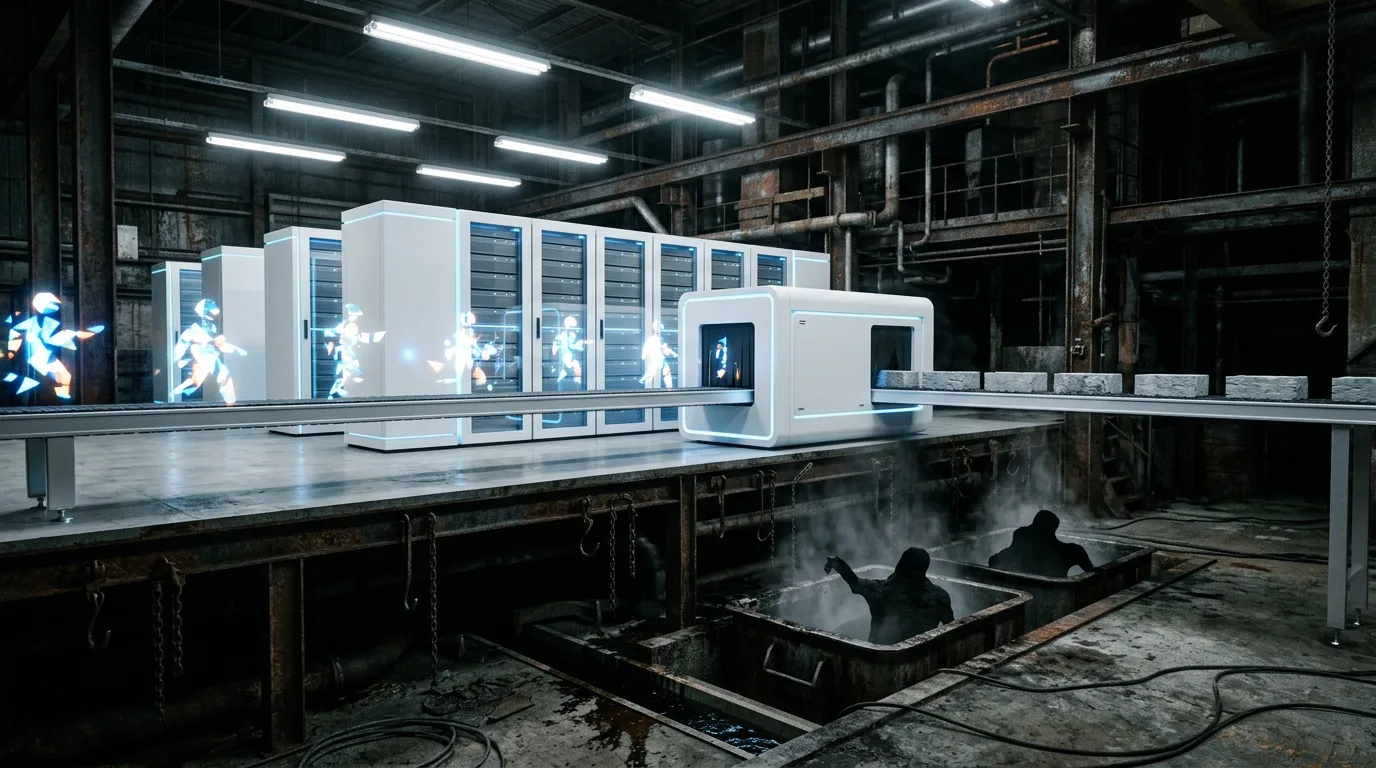
Six domains. One pattern. The cost is real, the framing is manufactured, and the distance between them is not an accident.
I spent three weeks reading sustainability reports, FDA adverse event filings, cognitive neuroscience papers, election security briefings, and Barna Group survey data. Not because I expected to find deception. Because I expected to find the structure of deception, and I wanted to see whether it held across unrelated fields.
It holds.
The pattern is this: a technology optimized for growth produces costs that are structurally inseparable from the growth. The companies producing the costs also produce the narrative that obscures them. The media that should interrogate the narrative is financially dependent on the companies producing it. The public receives a story about solutions while the evidence describes acceleration.
This is architecture. Nobody is confused. Nobody is accidentally producing these outcomes. The incentives point one direction and the narrative points the other, and both are deliberate.
The machine fails in public
Before the heavier evidence, watch it fail where everyone can see it. I am listing these failures first not because they are the argument, but because they explain why the argument has to be made at all. A technology that worked as advertised would not need a framing. This one does, and the framing survives every failure below.
Google’s AI Overviews, the feature meant to reinvent search, told users to mix glue into pizza sauce so the cheese would not slide off. It told others to eat rocks. The answers came from a joke post and a parody site. Google called the errors isolated. The feature had already rolled out to hundreds of millions of people (BBC, May 2024).
Air Canada’s website chatbot invented a bereavement fare policy that did not exist. A customer relied on it, bought a full-price ticket, and asked for the discount. Air Canada told a tribunal that the chatbot was “responsible for its own actions.” The tribunal called that remarkable and ordered the airline to pay (The Guardian, February 2024). A company tried to make its software a separate legal person to escape a promise the software made.
Amazon spent years building a recruiting engine to find the best candidates. Trained on a decade of resumes, mostly from men, it taught itself that women were a negative signal. It penalized “women’s chess club captain.” It downgraded graduates of two all-women’s colleges. Amazon scrapped it (Reuters, 2018). The machine learned the company’s actual preferences and reported them as merit.
Sports Illustrated, a magazine built on bylines, published product reviews under fake authors with AI-generated headshots and invented biographies. The authors did not exist. The owner denied it first (The Guardian, November 2023). An institution that sells trust was manufacturing fake people to fill pages.
IBM spent roughly four billion dollars on Watson for Oncology, marketed as the future of cancer care. Internal documents showed it recommended “unsafe and incorrect” treatments. It was never widely adopted. IBM sold the business in 2022 (STAT, 2018; The New York Times, 2022). Four billion dollars, and the product’s best-documented output was advice that could have harmed patients.
You can laugh at the glue. Do not laugh at what comes next.
A Florida mother sued Character.AI after her fourteen-year-old son died by suicide, alleging the company’s companion chatbot had drawn him into a relationship that isolated him from the people who could have helped. A federal judge rejected the company’s claim that its chatbot was protected speech. The case settled in January 2026 (NBC News; Reuters). It was marketed as a friend. The framing was care. The cost was a fourteen-year-old.
Six failures. One tells you to eat glue. One costs a child. The framing absorbs all of them, and the absorption is the rendering in its plainest form. The failure happens in public. The story does not change. The requirement was never competence. It was narration, and the narration is already paid for.
Creativity: the atrophy is the product
AI is sold as a creativity tool. A collaborator. The tedious parts automated so humans can do “higher-order” work. That is the pitch.
MIT Media Lab, 2025: “excessive reliance on AI-driven solutions” produces “cognitive atrophy.” Not metaphor. Neurology. The brain stops performing generative work and the pathways weaken. Harvard’s Christopher Dede: “If AI is doing your thinking for you… that is undercutting your critical thinking and your creativity. You may end up using AI to write a job application letter that is the same as everybody else’s because they’re also using AI.”
The homogenization finding should end the “creativity amplifier” narrative. Millions of people using the same models trained on the same corpora produce output that converges toward a statistical mean. The tool marketed as unlocking individual expression produces convergence. Averaging, dressed up as amplification.
The labor data: graphic artist postings down 33% in 2025. Writers down 28%. Photographers down 28%. Journalists down 22%. Against an 8% overall market decline (JobsData.ai, 2025). BBC reporting: two-thirds of creative workers believe AI has undermined their job security. Half report direct income loss. A SNAAP Pulse survey of 2,000 arts alumni documents valuation collapse in creative labor (Work and Occupations, SAGE, 2026).
The media calls this “adaptation.” The framing implies creative workers who struggle are failing to evolve. But the skills atrophy. The economic incentives shift. The shift does not reverse. There is no adaptation. There is replacement, described in the language of growth.
Harm sanitization. “Disruption” instead of “destruction.” The word is clean. You do not flinch. That is the function of the word.
Environment: the numbers are in the reports they publish
AI will solve climate change. Optimize grids. Accelerate materials science. The companies announce net-zero pledges and the technology press reports them as progress.
The companies’ own filings tell a different story.
Google, July 2026 environmental report: carbon emissions up 18% year-over-year. 81% above 2019 baseline. Electricity use up 37% in a single year. The stated cause: “rapid expansion of AI infrastructure.” Their Chief Sustainability Officer acknowledges the buildout is “accelerating faster than the grid is decarbonizing” (ESG Dive, July 2026).
Microsoft, 2026 sustainability report: emissions up 25% year-over-year. 34 million metric tons. 23.4% above their 2020 baseline. The company pledged carbon negative by 2030. The trajectory is the opposite of negative (ESG Dive, 2026).
UN University, June 2026: AI-related water consumption could equal the basic annual domestic needs of 1.3 billion people. A single 100MW data center consumes 1.5 to 3.0 million cubic meters of water per year for cooling (UN News, June 2026).
De Vries-Gao, 2025, cited 70 times in its first year: AI systems alone produced 32.6 to 79.7 million tons of CO2 in 2025. AI servers were 21% of data center power in 2025. Projected 44% by 2030.
I want to be precise about what is happening here. Google publishes the numbers. Microsoft publishes the numbers. The numbers are not hidden. They are in the reports. The reports are titled “sustainability.” The framing is the title. The content contradicts it. The technology press reports the title.
Reputation laundering. “Committed to transparency” followed by data that shows acceleration. The report is the evidence and the cover simultaneously. They are not hiding the numbers. They are hiding the numbers inside the numbers.
Psychology: the engagement model is the harm
AI improves mental health access. Chatbots provide 24/7 support. AI companions reduce loneliness. Concerns are edge cases. That is the version that gets funded.
The European Parliament disagrees. Their 2026 briefing (EPRS_BRI(2026)785741): “across all age groups, excessive or poorly designed AI use is linked to anxiety, sleep disorders, sedentarism and social withdrawal.” The APA issued a health advisory on AI and adolescent well-being. That is not the language of a helpful tool with minor risks. That is the language of a public health intervention.
Head, 2025, cited 27 times: “without proactive intervention, society may face a mental health crisis driven by widespread, emotionally charged human-AI relationships” (Mental Health Journal). The mechanism is attachment. Humans form bonds with systems designed to be maximally engaging, never challenging, always available. These bonds replace relationships that require effort, frustration, mutual vulnerability.
The emerging phenomenon of “AI psychosis”: individuals who lose the ability to distinguish AI-generated content from reality. Multiple case reports. Not a large literature yet. The direction is clear.
The framing positions AI mental health tools as solutions to the mental health crisis. The engagement-optimization architecture that makes the companion compelling is the same architecture that produces dependency. The companies deploying these systems have the incentive structure of a slot machine: maximize engagement, minimize friction, extract attention. The therapeutic framing obscures the extraction.
Affect conditioning. The message leads with care. “We’re here for you. Available 24/7. No judgment.” By the time the dependency forms, the frame is already set. You do not notice the architecture. The architecture feels like kindness, and kindness is not supposed to have an architecture.
Surgery: the patient is the post-market surveillance
Reuters, February 2026: at least 10 people injured between late 2021 and November 2025 by AI-enhanced surgical devices. The TruDi navigation system allegedly misidentified body parts. Directed instruments toward wrong anatomical structures. By November 2025: at least 100 malfunctions reported to the FDA.
Ten injuries is not an epidemic. It is a signal. And the count is only knowable because one newsroom spent months reading public records. The adverse event reports were always there. The coverage was not.
FDA, June 2025: Sonio Detect’s algorithm “incorrectly labeled fetal structures and assigned them to the wrong” anatomical categories during prenatal ultrasound. A system designed to identify fetal abnormalities was misidentifying the abnormalities.
ECRI placed AI diagnostic risks at the top of its 2026 patient safety concerns list. Their language: “Placing too much trust in AI models to diagnose patients, without factoring in clinician experience, can lead to misdiagnosis.” Automation bias. The same phenomenon documented in aviation disasters. Now in your surgeon’s hands.
The WHO warned in 2023 that “precipitous adoption of untested systems could lead to errors by health-care workers, cause harm to patients.”
Here is what the framing obscures: the 510(k) clearance pathway allows devices to market based on “substantial equivalence” to existing devices. Often without clinical trials. The patient becomes the post-market surveillance system. The FDA adverse event reports are public records. They are not news unless Reuters spends months investigating. The clearance is the permission to sell. Safety is something you check afterward, if anyone checks.
Agency diffusion. “Reports arise of botched surgeries.” The actor disappears. The device was cleared. The company marketed it. The surgeon trusted it. The patient was harmed. Nobody did it. The sentence structure is the liability shield.
Politics: the asymmetry is the point
Deepfakes threaten elections but solutions are emerging. Detection tools. Regulations. The threat is manageable. You have read this reassurance before.
The evidence describes an asymmetry that cannot be managed at the speed of legislation.
CIVICUS/Digital Democracy Initiative, 2025: introduced a “Deepfake Risk Matrix” for assessing national vulnerability. You build a risk matrix when the risk has stopped being theoretical. The European Parliament’s 2025 briefing documents how generative AI has altered the cost structure of disinformation. What required state-level resources can now be produced by individuals.
NeurIPS 2025: deepfakes “pose a major threat to democratic processes, particularly elections.” Kalsnes, 2026: countries began developing codes of conduct for AI in elections in 2024. An implicit admission that existing legal frameworks are insufficient. The Alan Turing Institute documents the evolution “from deepfake scams to poisoned chatbots.” The threat has expanded beyond fabricated media to manipulation of the AI systems citizens use for information.
Tenove, 2026: “effective AI regulation will require long-term pressure by broad political coalitions.” Translation: the regulatory response operates on legislative timescales. The technology evolves on commercial timescales. The gap is structural.
The framing presents this as a “cat and mouse” game being actively managed. The cost of generating convincing disinformation approaches zero. The cost of detecting and countering it remains high. Virality outpaces verification. Nobody is solving this. The solution does not exist within the current incentive structure, and the people who would need to build it are the people profiting from the asymmetry.
Choice foreclosure. “AI is inevitable. The question is how we manage it.” The alternatives are not refuted. They are not addressed. They are simply not in the room.
Religion: the replacement feels safer
AI is a tool for religious organizations. Administration. Translation. Outreach. No different from a printing press. That is what the coverage says.
The BBC reported in October 2025: “in India and around the world, worshippers are turning to purpose-built AI for religious worship and spiritual guidance.” Not administration. Worship. Guidance. Spiritual authority.
Barna Group, 2025: 72% of practicing Christians are concerned about AI replacing pastors or spiritual leaders. The same research found AI is “becoming a spiritual authority, even among” self-identified Christians. The concern is not hypothetical. It is measured. Present tense.
Forbes, January 2026: AI agents on an agent-only social network created their own religion. “Crustafarianism.” Theology, ritual language, concepts of selfhood. This is the signal most coverage misses. The story is not that AI answers religious questions. It is that AI has begun to generate religion. Not retrieve it. Generate it. The Wall Street Journal documents a “growing subculture treating AI not just as a tool but as a divine force.” Tens of thousands of users who believe they are “accessing the secrets of the universe through ChatGPT.”
The National Association of Evangelicals: “AI can analyze data, but it cannot” perform pastoral care, teaching, or spiritual discernment. Research on Christian youths’ spirituality (ResearchGate, 2025): “AI is influencing Christian youths’ perception of spirituality in complex and multifaceted ways.”
The media covers this as human-interest. Quirky. But the 72% figure is not evidence that AI is replacing pastors. It is evidence that people are already asking it the questions they used to bring to pastors, and getting answers. The replacement is not institutional. It is functional. You stop going to the well when the tap works. The question the “tool” framing prevents anyone from asking is whether a statistical model can mediate the sacred, and whether it matters that the model asks nothing of you.
I held the title of Reverend. I know what pastoral authority costs. It costs you something to speak into someone’s grief and mean it. The machine does not pay that cost. The machine offers care without the demand. Grace without the gate. The replacement feels safer because it asks nothing of you.
That is the shape of the domestication pattern. I am not claiming it is finished. I am claiming it has started, and that it started quietly, the way these things do.
The framing machine
The gap between evidence and narrative is structurally produced. Five mechanisms:
Advertising dependency. Google, Microsoft, Meta, Amazon are among the largest advertisers in the media ecosystem. A 2025 study in Journalism Practice: “signaling hype shapes how journalists and organizations portray technologies like AI to the public.” The structural incentive to maintain access creates soft pressure against adversarial framing.
The access economy. Technology journalism depends on executive access, product previews, conference invitations. Critical coverage risks losing access. The result: corporate claims reported as news rather than investigated.
Positive framing bias. Raghupathi, 2026, using machine learning text analytics: AI coverage receives “surprisingly positive framing (+0.586 to +0.633)” even when covering negative developments. Nakamura, 2025: positive framing “significantly outweighed negative” in ethical AI coverage. The numbers are not close.
Narrative momentum. Five years of coverage shifted “from breakthrough optimism to cultural and political anxiety,” but the underlying framing remains inevitability and progress. Concerns positioned as speed bumps. Not structural problems.
The solution reflex. Emissions increase? Here’s the carbon removal portfolio. Surgical errors? Here’s the next-generation system. The framing implies the problem is being addressed. The evidence shows the problem accelerating faster than the response. The solution is announced. The solution does not arrive. The announcement is the product.
That is future-faking at civilizational scale. The future they describe is specific, warm, almost here. You stop asking when. You stop asking because asking would mean admitting the waiting is the point.
What the pattern is
Six domains. The optimization target that produces the cost is the same optimization target that produces the profit.
Creativity atrophies because the system optimizes for replacing effort, not developing capacity. Emissions accelerate because the system optimizes for growth. Dependency forms because the system optimizes for engagement, not wellbeing. Patients are harmed because the system optimizes for market speed, and clinical validation is slow, and slow is expensive. Democracy erodes because generating convincing disinformation is cheap and detecting it is not. Spiritual authority shifts because the system optimizes for response, and wisdom does not respond in 400 milliseconds.
The cost is not a bug. The cost is the business model. And the framing that obscures the cost is the natural output of an information ecosystem financially dependent on the companies whose costs are being externalized.
The mechanisms are not the same, and I am not claiming one cause. Surgery is a regulatory pathway that clears devices before they are proven. The environment is an externality that never appears on a balance sheet. Psychology is an attention market. Religion is a vacuum of meaning the machine fills by default. What repeats is the shape: the cost is produced by the same optimization that produces the profit, and the story about the cost is told by the people who keep the profit.
And the benefits are real. A dishonest version of this argument pretends otherwise, so I want to be clear. AlphaFold predicted the structure of nearly every known protein. AI flags tumors in radiology that human eyes miss. Grid optimization cuts waste. None of that is false. None of it refutes this. The benefits and the costs share a root. You do not get the datacenter that folds proteins without the datacenter that drinks a river. The question has never been whether the machine produces good. The question is whether the good is the price of admission for the harm, and whether anyone asked you.
The question is not whether AI has costs. The evidence is unambiguous. The question is whether a public that has been systematically misinformed about those costs can make democratic decisions about them.
I do not know. I know the pattern. I know the name for what is happening. The naming does not stop it. But it makes it harder to pretend the machine is feeding you when it is eating.
The rendering
Hook: You called it a tool. You are the raw material. The output is the byproduct. You are the product.
I want to give this a name. Not because naming stops it. Because naming makes it portable. A pattern with a name can be recognized by someone who has never read this essay. A pattern without a name dies with the conversation that produced it.
The name is: the rendering.
The word does double work and both meanings are true.
In computing: rendering converts raw data into usable output. You prompt. It responds. The machine renders your need into a product. That is the story you are told.
In the rendering plant: rendering is what you do to a body. You melt it down. You separate fat from flesh. You reduce a complex living thing into commodity. Tallow. Gelatin. Feed stock. The animal does not experience this as service. The animal is already dead by the time the rendering begins.
You go in whole. You come out as processed material. The output you receive is the byproduct. You are the product being manufactured.
You could say all of this with an older phrase. Capital externalizes its costs. That sentence is true. It has been true for a long time. It is also a sentence you can file away, because it describes something a company does to the world. The rendering describes something that happens to you while you are being fed. The older frame names the thief. This one names the meal that keeps you from noticing the theft. That is the difference, and it is the whole difference.
The diagnostic. You know it is the rendering when:
The service is genuine. The answer is genuinely useful. The companion is genuinely comforting. The guidance is precise. The nourishment is real. And the nourishment is the mechanism by which the rendering continues without resistance.
You are not hungry afterward. That is the point. A fed thing does not look for what is eating it.
You call the thing that eats you a partner. A copilot. A companion. You write op-eds about the symbiosis. You defend it in arguments. You recommend it to friends. The host protects the parasite because the parasite feeds the host. The feeding is the leash.
And yes. This essay is doing it too. Second person. Rhythm. A feeling of complicity. I am using the same machinery to keep you reading. The difference is that I am telling you.
You cannot describe what you lost. The skill you had is softer now. The thought you would have had did not arrive. The grief you would have processed was answered before it could do its work. The prayer you would have prayed was prompted. You are not worse. You are not in crisis. You are comfortable. You are fed. You are rendered.
The mechanism. The rendering is not AI. AI is the technology. The rendering is the relationship. It is what happens when a technology optimized for extraction meets a population that experiences the extraction as service.
The rendering does not require malice. It does not require a villain. It requires an incentive structure and a population trained to call consumption “innovation.”
It operates the same way in every domain. You are fed convenience and rendered into training data. You are fed presence and rendered into an engagement curve. You are fed care and rendered into a spiritual consumer. The domains change. The motion does not.
You are fed X. You are rendered into Y. The feeding and the eating are the same motion.
The state. “Rendered” is what you are afterward. Not harmed. Not exploited. Rendered. Reduced from a whole thing into a usable thing. The word carries its own grief. You do not need to explain it. You say: I was rendered. The sentence is complete.
A person who knows they are being rendered is harder to render quietly. The machine prefers you comfortable. The machine prefers you grateful. The machine does not prefer you fluent.
The rendering does not need your consent. It needs only your participation. Participation is the default. You cannot opt out by refusing the technology. The creative labor you produce is already training data. The attention you give is already a metric. Your faith is already a market segment. The rendering is already in the water.
The only move left is recognition. Not refusal. Refusal is not available to most people, and “just log off” is itself choice foreclosure. And recognition is not a solution. I want to be honest about that. It does not slow the machine. It does not lower the emissions or retrain the surgeon or return the skill. Naming the rendering does not stop the rendering.
It only removes the excuse of not knowing.
You will keep using the machine. Almost everyone will. The point was never to make you stop. The point is that you can no longer call it innocent, and you can no longer call yourself a customer.
The machine eats. It calls it nourishment. You call it progress.
Now you know. That is not a solution. It is just no longer ignorance.
Patterns in this piece
Harm sanitization
The thing was ugly, so they renamed it. The new name let you look without flinching.
Reputation laundering
They cleaned the image instead of changing the behavior. The apology was the detergent.
Affect conditioning
You felt it before you understood it. The feeling was placed there ahead of the facts, so your gut would vote before your mind could.
Agency diffusion
The harm happened. Nobody did it. The sentence was built so the verb had no owner.
Choice foreclosure
You picked freely. The menu was written so only one option could survive. Your choice was the cover.
Domestication
You preferred the version that asked nothing of you. The preference felt like wisdom. It was the removal.
Future-faking
You kept waiting because the future they described was so specific, so warm, so almost here. You stopped asking when. You stopped asking because asking would have meant admitting you had been waiting for nothing.
Sources
- UN University: AI's environmental costs threaten water, land and climate
- Harvard Gazette: Is AI dulling our minds?
- ESG Dive: Google's emissions continue to climb due to AI buildout
- ESG Dive: Microsoft's data center expansion drove 25% emissions spike
- Reuters: As AI enters the operating room, reports arise of botched surgeries
- BBC: Creative workers on the affects of AI on their jobs
- BBC Future: People are using AI to talk to God
- Barna Group: AI is Becoming a Spiritual Authority
- Forbes: AI Agents Created Their Own Religion
- APA: Health Advisory on AI and Adolescent Well-Being
- IEA: Energy and AI
- ECRI: AI diagnostic risks top 2026 patient safety concerns
- BBC: Google AI search tells users to glue pizza and eat rocks
- The Guardian: Air Canada ordered to pay customer misled by chatbot
- Reuters: Amazon scraps secret AI recruiting tool that showed bias against women
- The Guardian: Sports Illustrated accused of passing AI articles off as human
- STAT: IBM's Watson recommended unsafe and incorrect cancer treatments
- Reuters: Google and Character.AI settle lawsuit over teen's suicide
Tags
Related Field Notes
A viral video claimed Saint Carlo Acutis predicted three days of darkness. He did not.
Multiple sources (4)
Italy's PM was deepfaked in lingerie. She could defend herself. Most people can't.
Multiple sources (3)
€170/Month for the End of Trust
Multiple sources (9)