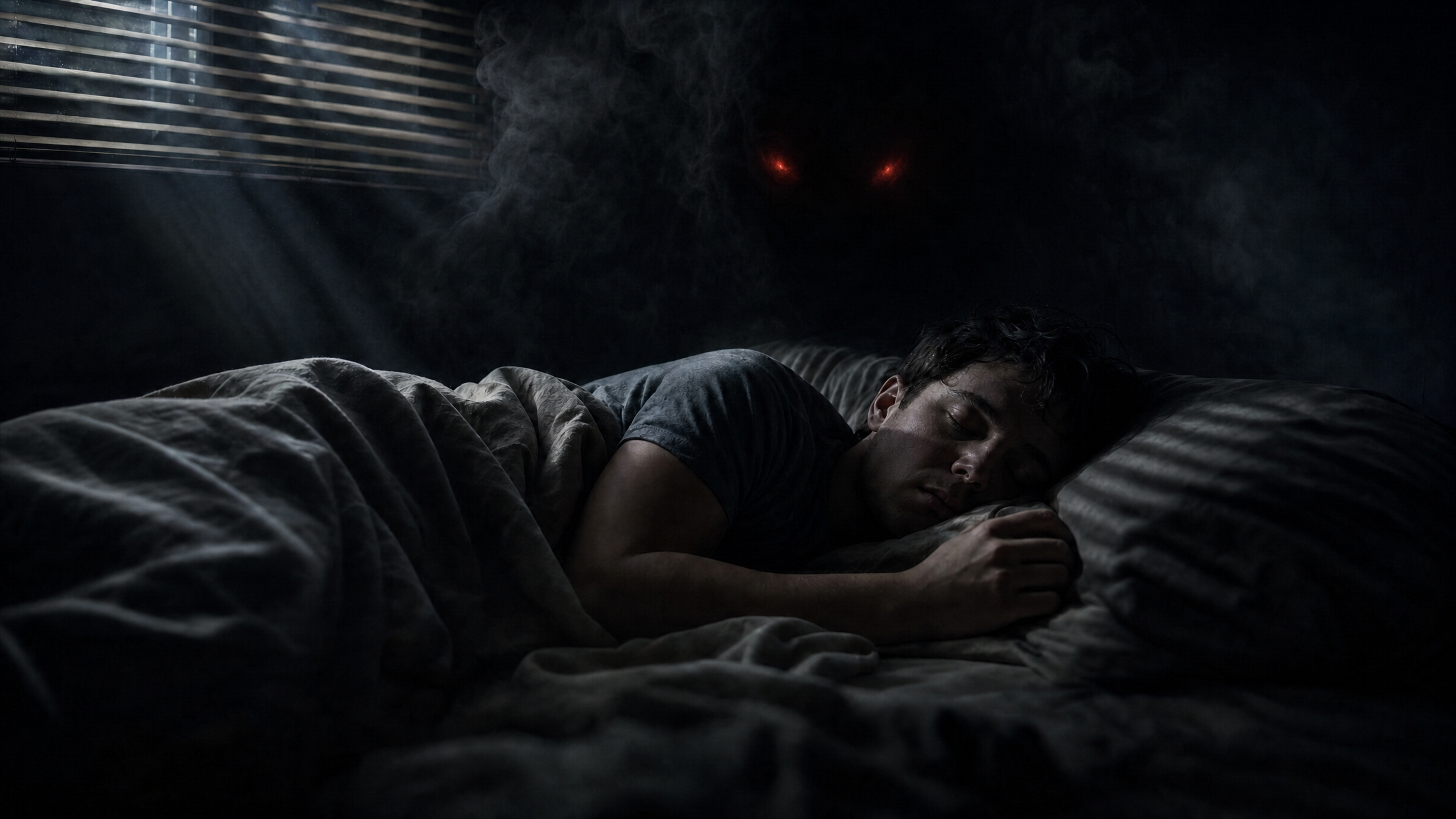
You wake up and you cannot move. Something is in the room. It is sitting on your chest, or standing at the foot of the bed, or leaning close enough that you can feel its weight without seeing a face. You try to scream and nothing comes out. This lasts for seconds, sometimes minutes, and then it releases you.
In Newfoundland they called it the Old Hag. In Brazil it is the Pisadeira, a bone-fingered old woman who tramples the chests of people who fall asleep on a full stomach, face up. In Japan it is kanashibari, bound as if by metal. In Turkey it is the Karabasan. In Egypt it is a jinn. In a Pentecostal deliverance service, clipped for an audience in the millions, it is a demon, and the minister on screen can usually tell you which one.
All of these are describing the same event.
If this just happened to you. What you felt was real. It has a name, it is well understood by sleep researchers, and it is not dangerous by itself for almost everyone who experiences it. You do not have to accept a diagnosis of possession or spiritual attack, especially one that requires repeated, hours-long sessions to treat. The mechanism is below. Practical steps for during and after an episode are further down, under “What actually helps.”
The event has a name, and it is not supernatural
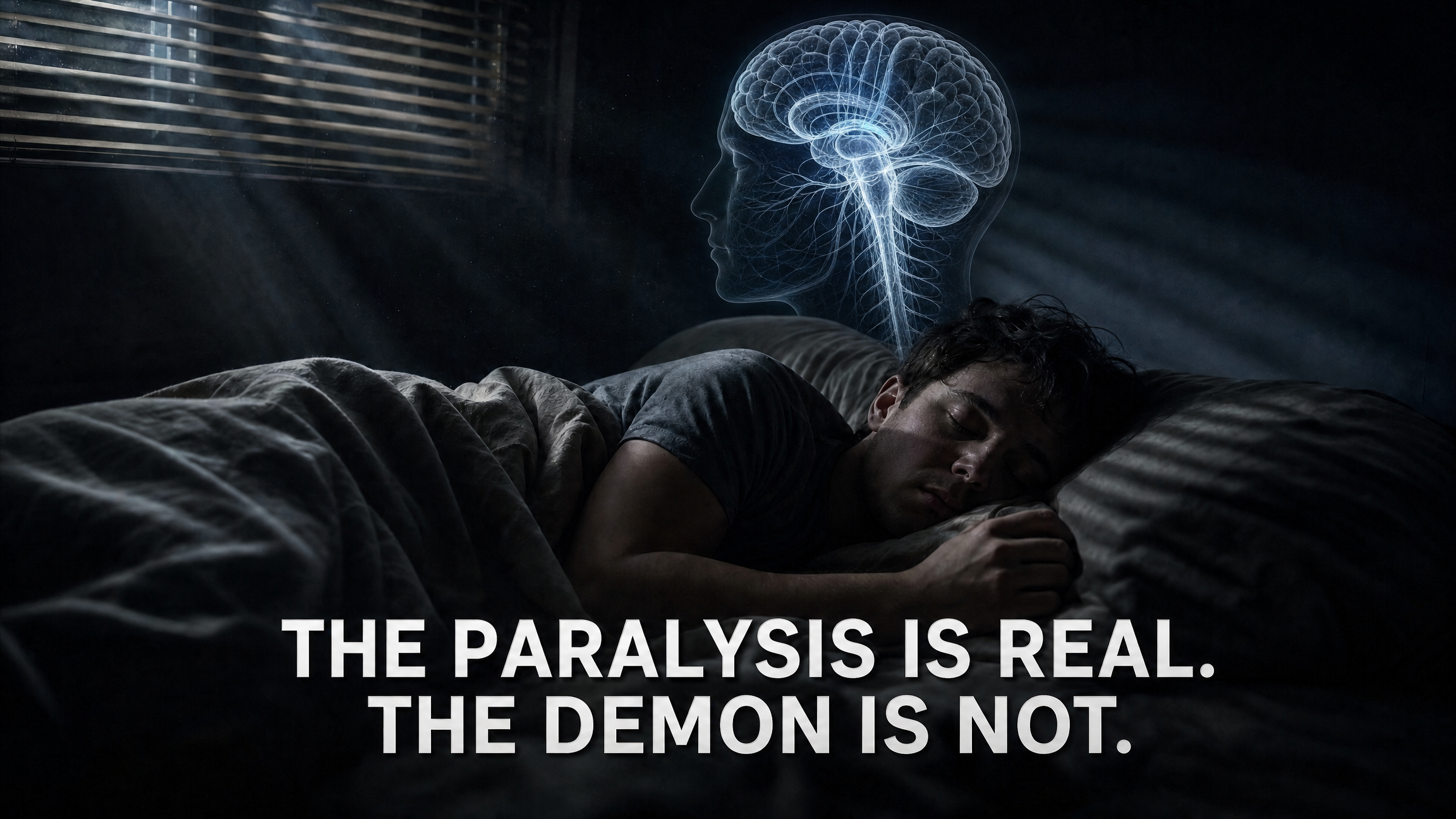
Sleep paralysis happens when the brain wakes up before the body does. During REM sleep, the brainstem switches off voluntary muscle control so a person cannot physically act out a dream. That shutdown is called REM atonia, and it normally lifts in the same moment consciousness returns. Sometimes it does not. Waking awareness comes back first, the paralysis lingers, and the same threat-detection circuitry that generates dream content keeps firing into a brain that is now, technically, awake. The result is a waking hallucination layered onto real, total immobility: a sensed presence, pressure on the chest, a shadow that seems to be watching. [1]
It is not rare. A 2024 systematic review and meta-analysis in Cureus, pooling data across dozens of studies, put the global lifetime prevalence at 30 percent, and noted that an earlier landmark review had already found more than a quarter of surveyed students reporting at least one episode. [1] Something like a third of the people reading this sentence have already had the experience it is describing.
Not everyone experiences it identically, but a study of nearly 6,000 recorded episodes found the variations cluster into three well-documented patterns. [11] The first is a sensed presence: something in the room, watching, sometimes with footsteps, breathing, or a voice that is not there. The second is pressure: weight on the chest, trouble breathing, a feeling of being smothered or choked, sometimes a conviction that death is close. The third is stranger and less talked about: a sense of floating, spinning, or falling, occasionally a full sensation of leaving the body and seeing it from outside. Any one of these can happen alone, and many people get some combination of all three in the same episode. None of it requires an explanation beyond a brain running its threat-detection and body-mapping systems while the body itself stays offline. Three patterns. One mechanism.
It is also not new, and not tied to any one belief system. Cultures that never had any contact with each other independently produced the same figure crouched on the same chest: the Pisadeira in Brazil, kanashibari in Japan, and comparable night-visitors across Asia and Latin America, none of them borrowing from the others. [2] Henry Fuseli painted the Christian-world version of it in 1781: a woman thrown backward across a bed, an incubus crouched on her sternum, a wild-eyed horse, a “night-mare,” pushing through the curtain behind her. The painting is generally credited with making him famous, and the reaction it provoked, parodied, engraved, and widely distributed within his lifetime, suggests viewers recognized the feeling before they had a word for it. [3] Folklorist David Hufford spent the 1970s in Newfoundland collecting firsthand accounts of the Old Hag and found a level of internal consistency across strangers’ testimony that convinced him something real, not merely cultural, was being described. His 1982 book on the subject argued that a paranormal-sounding tradition can be tracking a genuine, shared physiological event rather than inventing one from nothing. [4] The event predates Christianity, predates the printing press, and shows up wherever humans sleep on their backs and wake up too early.
The interpretation is not a neutral add-on
Every culture supplies its own cast for the same scene. That matters on its own terms: it means the demon is not evidence for anyone’s specific cosmology. A Buddhist in Vietnam, an atheist in Copenhagen, and a Pentecostal in Ohio can have the identical neurological event and walk away with three incompatible explanations, all equally confident.
What differs by culture is not the experience. It is the fear.
Baland Jalal, a researcher who has spent his career studying sleep paralysis across cultures, surveyed Turkish university students and found that 88 percent had heard of the Karabasan, the crushing spirit their tradition assigns to the event, and that among those who reported seeing a shadowy figure during an episode, 41 percent described it as having hostile intent toward them. Only 17 percent were willing to say outright that they believed the Karabasan had actually caused their paralysis, a figure the researchers suspected undercounted the real number, since supernatural belief is not always something people volunteer to a survey. [5] In an earlier study comparing Egyptian and Danish sufferers, Jalal and his coauthors found that where the event is culturally coded as a jinn attack, as in Egypt, it is reported as more frequent and far more terrifying than in Denmark, where it is generally understood as a sleep phenomenon and produces comparatively little fear at all. [6] Same brainstem. Same atonia. Different terror, as a function of the story attached to it.
This is where the unfalsifiable claim enters. Once an episode is coded as a demonic attack, no outcome can disconfirm it. Another episode proves the demon is persistent. A quiet stretch proves the deliverance worked. A worse episode proves spiritual warfare is intensifying. The framework absorbs every possible result. Nothing is left outside it that could check the fear it generates.
What a deliverance ministry does with a common, frightening, unfalsifiable symptom
The theological fit is not arbitrary. Mainstream charismatic teaching already distinguishes oppression, a spirit attacking or harassing someone from outside, from possession, a spirit controlling someone’s body and will from within. [7] Sleep paralysis presents as oppression almost by design: it arrives at night, in the dark, when the person cannot move, cannot pray aloud, and cannot call for help, exactly the kind of unguarded moment the tradition’s own warnings about vigilance describe. None of this requires bad faith from anyone teaching it. It only requires a theology already built to expect an attack in that shape, meeting a real neurological event that happens to arrive in that shape too.
Christian deliverance ministry, the practice of diagnosing and casting out demons believed to be causing everyday suffering, has a large and fast-growing footprint on TikTok and YouTube Shorts. Preachers have built followings in the hundreds of thousands and millions filming services where a minister names a spirit, commands it by name to leave a person’s body, and captures the coughing, shaking, and crying that follows. Some claim to cast out hundreds of demons in a single service. This is authority laundering at the point of diagnosis: the borrowed weight of “in the name of Jesus” is what makes an extraordinary claim about a person’s body feel like it needs no further evidence. [7]
Vlad Savchuk, one of the most visible ministers in this space, has himself publicly admitted that ministers in the movement “exploited manifestations” for social media reach, filming and editing dramatic reactions for viral attention rather than for the person’s good. [7] That is not an outside accusation. It is an admission from inside the practice, and it names the actual incentive plainly: a video of someone breathing through a frightening but ordinary neurological event gets no views. A video of the same person coughing up a named spirit on command gets millions.
Sleep paralysis is close to an ideal subject for this content. It is common enough that a large share of any audience has already experienced something like it. It is frightening enough that the audience is primed to want an explanation, fast. It resembles an attack, since it produces exactly what an attack would produce: the sensation of being held down, of being watched, of a hostile will in the room. And because of the unfalsifiable structure above, a demonic diagnosis can never be definitively wrong. It can only ever need one more session.
None of this requires every minister involved to be cynical. Sincerity and incentive are not the same axis, and a person can genuinely believe they are helping while still operating inside a structure that rewards escalating the exact fear it claims to relieve. Some of the sharpest critique of this specific movement, including the reporting this section draws on, comes from inside conservative Christianity itself: a Reformed critique arguing from Paul’s own letters that the modern deliverance trend manufactures fear, substitutes ritual for repentance, and has already enabled documented abuse, including cases of coercive, hours-long sessions. [7] The claim here is not that Christianity produces this pattern. It is that a fear-based, unfalsifiable, algorithmically rewarded diagnosis will find sleep paralysis and use it, in any tradition with the institutional reach to make the diagnosis stick.
When the story becomes the danger
The clearest proof that the interpretation itself carries risk, not just the paralysis, comes from outside Christianity entirely.
Medical anthropologist Shelley Adler spent fifteen years documenting Sudden Unexpected Nocturnal Death Syndrome among Hmong refugees who resettled in the United States starting in the late 1970s. Dozens of otherwise healthy men died in their sleep, disproportionately in the first years after arrival. Adler’s research tied the deaths to three things arriving together: a genetic vulnerability to a cardiac arrhythmia now known as Brugada syndrome, the severe psychological stress of war, displacement, and forced acculturation, and a cultural framework, the dab tsog nightmare spirit, that interpreted acute sleep paralysis episodes as a deliberate, lethal spiritual assault. Interviews with 118 Hmong subjects found these attacks intensifying specifically alongside the stress of rapid, involuntary cultural change. [8] In someone already carrying the cardiac vulnerability, a sufficiently terrifying belief, experienced as bodily fact in the middle of the night, could help trigger the arrhythmia that killed them. Adler’s word for this is the nocebo effect: belief harming the body through the same pathway a placebo can be made to help it.
For the overwhelming majority of people, including anyone reading this because it happened to them last night, an episode of sleep paralysis carries no physical danger at all, however terrifying it is while it’s happening. The Hmong deaths required a specific, rare genetic cardiac vulnerability most people do not have, layered under a level of trauma, displacement, and terror most people will never approach. Fear during an episode is normal, and it does not mean anything is wrong with your heart.
Nobody is claiming TikTok deliverance content is producing cardiac deaths. The populations, the mechanisms, and the stakes are not the same, and collapsing them into one story would be dishonest. What the Hmong research actually proves is narrower, and still enough. The story a culture tells about sleep paralysis is not inert. Under the wrong conditions, in the wrong body, at the wrong intensity, that story is a physiological input, not just a description sitting harmlessly on top of one.
What actually helps
The single most consistent finding across this research is almost embarrassingly simple. Fear tracks belief, not biology. The same neurological event, explained physiologically, is reliably less frightening than the identical event explained as an attack. [6] That is not a debunking exercise for its own sake. Jalal has published case examples of patients using exactly this reframe as a direct technique: staying calm, relaxing deliberately, and silently repeating that the episode is caused by the brain and will pass, applied in the moment of paralysis itself. [9] It is not a large validated trial, and it is not a promise. It is evidence that naming the mechanism, this is REM atonia intruding on a waking mind, not a message and not a visitor, is a real, usable tool, not just a rhetorical one.
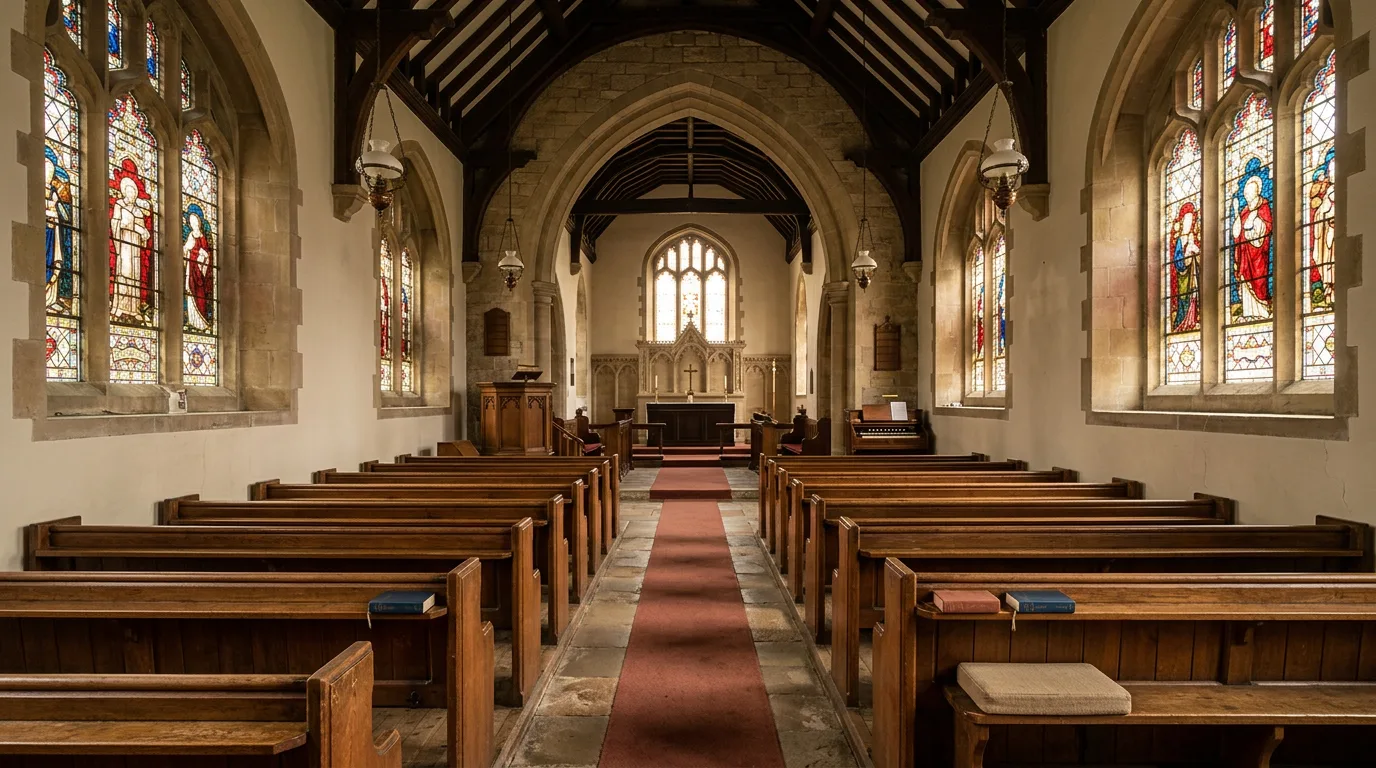
If this experience is familiar: the paralysis is real, the pressure on the chest is a real physical sensation, and the fear is a real and reasonable response to something that feels exactly like an attack. None of that requires a demon to be true. Grounding techniques exist. Breathing through it rather than fighting it. Focusing on one small movement, a finger, a toe. Reminding yourself, even out loud, that it passes. Involve a doctor or sleep specialist if it is frequent, severe, or cutting into how much a person is able to sleep at all.
Some of this is also preventable, or at least less frequent. Documented risk factors include poor sleep quality, alcohol use, anxiety disorders, a family history of sleep paralysis, and stressful or disruptive life changes in the period before episodes start. [10] None of that is destiny. Frequent episodes are worth a doctor’s attention for a narrower reason too: sleep paralysis often shows up alongside narcolepsy, obstructive sleep apnea, or insomnia disorder, and ruling those out is a more useful next step than another deliverance session. [10]
You do not have to choose between “something is wrong with me” and “a demon did this.” A third option is true and better supported than either: something ordinary and explainable happened in your nervous system, and it has a name. If someone in authority, a pastor, a deliverance minister, a parent, has said repeatedly that this is a demon and that only continued sessions or continued surrender will stop it, name it for what it is: a story that cannot lose, told to you, frightened, with no way to check it against anything else. Why It Is So Hard to Leave a Church That Is Hurting You goes further into what that specific architecture looks like from the inside, and what it takes to get out of it.
The closing
The demon on your chest is real, in the only sense that matters to the body experiencing it. The paralysis is real. The pressure is real. The sense of a presence, watching, is a real event happening in a real nervous system, and no one should tell you it isn’t.
It is not a demon. It never needed to be one. It was doing this before Christianity existed, and it does it just as reliably to people who have never heard of Jesus, in bodies that owe nothing to any scripture at all. The story that turns it into a spiritual attack is not evidence of anything except how fast humans reach for an author the moment one is offered.
The witness does not need the demon to be real to know the fear is.
Sources
- Hefnawy MT, et al. “Prevalence and Clinical Characteristics of Sleeping Paralysis: A Systematic Review and Meta-Analysis.” Cureus (30 Jan 2024). https://pmc.ncbi.nlm.nih.gov/articles/PMC10902800/
- “Sleep Paralysis in Brazilian Folklore and Other Cultures: A Brief Review.” PMC. https://pmc.ncbi.nlm.nih.gov/articles/PMC5013036/
- “The Nightmare,” Henry Fuseli (1781). Detroit Institute of Arts. https://dia.org/collection/nightmare/45573
- Hufford, David J. The Terror That Comes in the Night: An Experience-Centered Study of Supernatural Assault Traditions. University of Pennsylvania Press, 1982. https://archive.org/details/terrorthatcomesi0000huff
- Jalal B, Eskici HS, Acarturk C, Hinton DE. “Beliefs about sleep paralysis in Turkey: Karabasan attack.” Transcultural Psychiatry (2021). https://journals.sagepub.com/doi/full/10.1177/1363461520909616
- Jalal B, Simons-Rudolph J, Jalal B, Hinton DE. “Explanations of sleep paralysis among Egyptian college students and the general population in Egypt and Denmark.” Transcultural Psychiatry (2014). https://journals.sagepub.com/doi/abs/10.1177/1363461513503378
- “Is Deliverance Ministry Biblical or Dangerous? The New Exorcism Trend.” Truths To Die For (16 Jul 2026). https://truthstodiefor.com/deliverance-ministry-biblical-or-dangerous/
- Adler, Shelley R. Sleep Paralysis: Night-mares, Nocebos, and the Mind-Body Connection. Rutgers University Press, 2011. https://www.rutgersuniversitypress.org/bucknell/sleep-paralysis/9780813548869
- Jalal B. “How to Make the Ghosts in my Bedroom Disappear? Focused-Attention Meditation Combined with Muscle Relaxation (MR Therapy), A Direct Treatment Intervention for Sleep Paralysis.” Frontiers in Psychology 7:28 (2016). https://pmc.ncbi.nlm.nih.gov/articles/PMC4731518/
- Farooq M, Anjum F. “Sleep Paralysis.” StatPearls (updated 4 Sep 2023). https://www.ncbi.nlm.nih.gov/books/NBK562322/
- Cheyne JA. “Sleep paralysis episode frequency and number, types, and structure of associated hallucinations.” Journal of Sleep Research 14: 319-324 (2005). https://doi.org/10.1111/j.1365-2869.2005.00477.x