The Door-Knock Pattern: How Criticizing Israel Got a Knock on the Door in Eight States
Evidence-first pattern recognition. Sourced to reputable reporting.
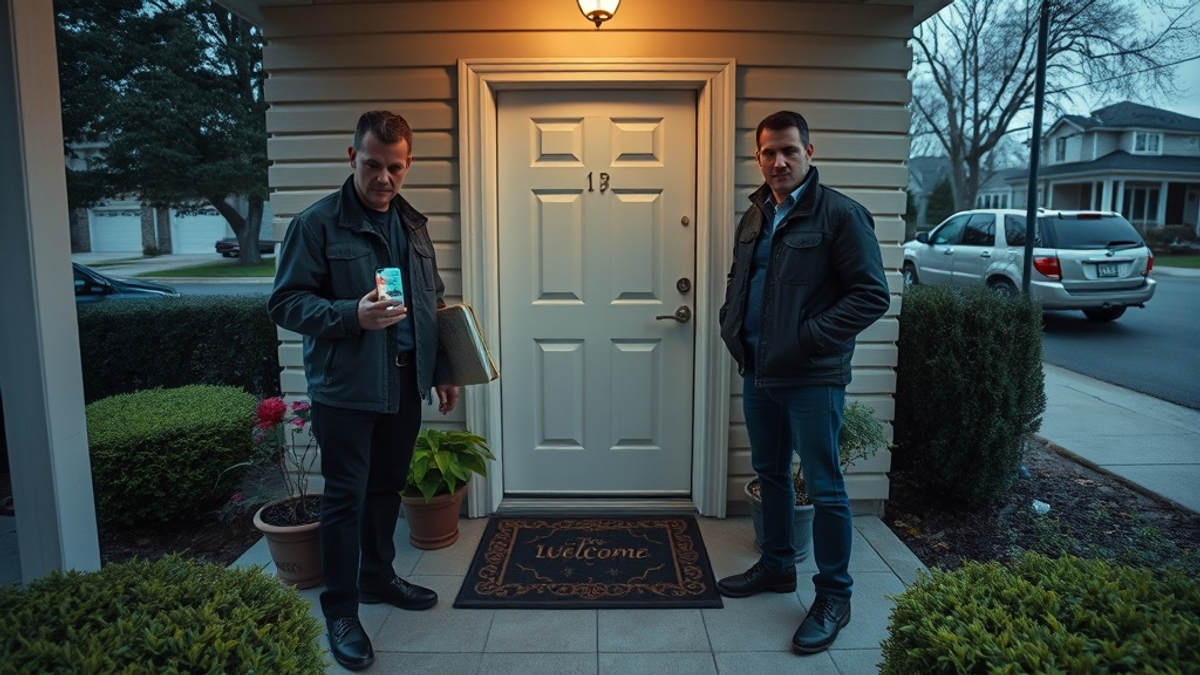

The Pattern
The pattern is not the knock on one door. The pattern is that the same knock happened in eight states, at different agencies, across three years, and the common denominator was never the person behind the door. It was the sentence they posted about one country.
A Syracuse University professor. On October 10, 2023, three days after Hamas attacked Israel, an FBI agent appeared on the doorstep of Mara Sapon-Shevin, a professor who had organized with Jewish Voice for Peace. He unfolded his badge and asked for her by name. He said he was there “because a year ago you co-organized a demonstration for Palestinian justice.” He asked if, “given the current moment,” there were any Palestinians she was “worried about.” She declined to speak. He left his business card. Palestine Legal confirmed it was not the first FBI encounter reported to their office. The knock came before the bombs.
A disabled Navy veteran in Texas. State police entered his property without a warrant on October 29, 2025. When he asked why, an officer said they came “because of your online comments about the Jewish community.” He invoked the First Amendment and told them to leave. The video went viral.
A Muslim woman in Stillwater, Oklahoma. Three FBI agents arrived on March 19, 2024. They told her Facebook had sent them screenshots of her posts. One agent said, on camera, “We do this every day, all day long, talk to people.” She refused to answer without a lawyer. CAIR Oklahoma confirmed the agents were real.
A retired Marine lieutenant colonel in Nashville. Two FBI agents visited his family home on July 29, 2024 while he was out of the country. They questioned his daughter about his whereabouts and told her to have him report to a nearby embassy. His offense: LinkedIn and YouTube posts criticizing U.S. officials for complicity in Gaza and citing the Leahy Law. He filed a FOIA request. No file on him existed. The FBI admitted the “allegation” came from “another office in the government.”
A political activist in Miami Beach. Detectives in an unmarked vehicle knocked on her door in January 2026 over a Facebook comment criticizing the mayor, who is Jewish and pro-Israel. An officer read her comment back to her, including three � emoji she had posted, and said it “can probably incite somebody to do something.” She asked if she was being charged with a crime. She was not. She is now suing the city.
A Palestinian American in Tarrant County, Texas. He spray-painted “Fuck Israel” on a church flying the Israeli flag. The county prosecuted it as a hate crime carrying up to a decade in prison. A jury rejected the elevation and convicted on misdemeanor criminal mischief. The judge added 180 days in jail as a probation condition anyway.
A Turkish doctoral student at Tufts. Six plainclothes ICE agents, faces covered, grabbed Rümeysa Öztürk on a residential street in Somerville at 5:15 p.m. on March 25, 2025. She was walking to a Ramadan iftar dinner with friends. One agent took her phone from her hands. Another told her to “take a breath.” A neighbor watching from a balcony asked, “Is this a kidnapping?” She was held in Louisiana for six weeks. Her offense: co-authoring an op-ed in the student newspaper calling on Tufts to acknowledge the Palestinian genocide and divest from Israeli corporations. There was no mention of Hamas in the op-ed. Canary Mission had listed her for it. The door-knock had become a street-grab.
A Providence city councilor. Fired from his day job in the Rhode Island governor’s office in October 2023 for posting pro-Palestinian political opinions online. The chief of staff told him his posts conflicted with the governor’s views.
Eight students at the University of Michigan. On June 10, 2026, at 7 a.m., the FBI executed arrest warrants across multiple states. Flash bangs. Doors broken. Eight pro-Palestinian activists, ages 21 to 28, arrested on a 10-count federal indictment. The charges: conspiracy to transmit threats, witness tampering, destruction of property. The DOJ called them aspirants to the “Weather Underground.” FBI Director Kash Patel announced the arrests on social media. The indictment covered conduct from October 2023 to April 2025. The same street in Ypsilanti had been raided by the FBI in April 2025. The door-knock had become a door-breaching raid.
Different people. Different states. Different agencies: FBI, state police, city detectives, county prosecutors, ICE, employers. Citizens and noncitizens. Veterans and students. Muslims, Christians, and Jews. The escalation from knock to grab took 12 months. The escalation from grab to raid took 15 more. The common denominator never changed: criticism of Israel.
That is the surface. Below it is an architecture with named components, a funding trail, a legal framework, a surveillance layer, an immigration filter, a foreign government operating inside the United States, and a coordinated international pattern across four countries.
The legal framework
The mechanism that converts “criticism of Israel” into “antisemitism” into “hate crime” into “terrorism” is not improvised. It is codified.
In December 2019, President Trump signed Executive Order 13899, directing federal agencies to enforce Title VI of the Civil Rights Act against antisemitism using the International Holocaust Remembrance Alliance (IHRA) working definition. The IHRA definition includes “double standards” toward Israel as an example of antisemitism. The definition was drafted in 2004–2005 by Kenneth Stern as a data-tracking tool for European countries. It was never intended as a legal framework. Stern has said so publicly.
In early 2025, Trump signed a second executive order that “reaffirms” EO 13899 and goes further. It encourages the attorney general to use the Ku Klux Klan Act, a federal anti-KKK statute, against pro-Palestinian protesters. It directs every federal agency to inventory all powers they can use to “curb or combat antisemitism.” It orders monitoring and reporting of foreign students. The Forward obtained the draft.
As of 2025, 37 states have adopted the IHRA definition. That is why local and state police are the ones showing up in some cases. The definition is not a federal-only instrument. It has been distributed into state law enforcement.
Stern, the author of the definition, told NPR in March 2025 that the Trump administration is weaponizing it to stifle speech, including Jewish speech. “It puts pro-Israel Jewish students in a situation where they may be seen as trying to suppress speech rather than answer it,” he said. The person who wrote the definition is on record saying the government is using it for the opposite of its purpose.
The legal pipeline runs: criticism of Israel → IHRA definition → antisemitism → hate speech → hate crime → terrorism. Each step is a reclassification. Each reclassification expands the enforcement toolkit. By the time the sentence reaches a police officer’s mouth, it has been laundered through four categories that did not describe the original speech.
The policy blueprint: Project Esther
The executive orders did not appear from nothing. They were drafted from a 33-page document called Project Esther, published by the Heritage Foundation in October 2024, the same group behind Project 2025.
Axios reported that Project Esther defines the entire pro-Palestinian movement as a “Hamas Support Network” and calls for:
- Public firings of pro-Palestine professors
- Using anti-racketeering (RICO) laws to break up pro-Palestine groups
- A “propaganda purge” from classrooms
- Denying noncitizens access to universities for Palestine advocacy
- A 24-month timeline to “dismantle the infrastructure”
Politico analyzed the document and found the Trump administration has followed 47 of its points.
The Heritage Foundation is funded by the same donor network that funds the doxxing groups and the campus surveillance operations. The pipeline runs from donor to think tank to executive order to enforcement. The blueprint is not a prediction. It is a checklist.
The surveillance layer
The door-knocks are not triggered by human reporting alone. They are fed by automated systems.
Amnesty International documented in August 2025 that two AI tools, Palantir’s Immigration OS and Babel Street’s Babel X, are being used by DHS and the State Department for mass monitoring of visa holders and social media scanning. Babel X can gather data from a single identifier: a name, an email, a phone number. It accesses social media posts, IP addresses, and location data. It has been used by CBP since at least 2019.
The State Department’s “Catch and Revoke” initiative, reported by Axios in March 2025, uses AI to review the social media accounts of tens of thousands of student visa holders. Officials examined 100,000 people in the Student Exchange Visitor System since October 2023. If a post appears “pro-Hamas,” that is grounds for visa revocation. The Brennan Center’s Faiza Patel told Democracy Now the “catch” part relies on two sources: doxxing organizations that claim to have provided information to the State Department and DHS, and social media scraping.
Palantir is the same company that built ICE’s Investigative Case Management system during Trump’s first term, the system used to build profiles of immigrant families for deportation. Palantir told The New York Times it did not work with ICE’s Enforcement and Removal Operations. FOIA documents proved it did. The firm is now selling predictive policing and immigration targeting as a product line. The product is the pattern. The pattern is the product.
In the Oklahoma case, the FBI told Rolla Abdeljawad that Facebook had handed them screenshots of her posts. Whether true or a fishing expedition, the platform is either complicit or being used as a cover story. The surveillance does not require a warrant. It requires an identifier and a tool.
The immigration filter: codifying the pattern into the system
In April 2026, The New York Times obtained internal DHS training materials instructing immigration officers to deny green cards to applicants who posted criticism of Israel on social media or participated in pro-Palestinian campus protests. Reuters confirmed the guidance. JTA reported the details.
The training materials, distributed to officers at U.S. Citizenship and Immigration Services, cite as an example of questionable speech a social media post that reads “Stop Israeli Terror in Palestine” with the Israeli flag crossed out. Another example: a map of Israel with the country’s name crossed out and replaced with “Palestine.” Officers were told to “focus particularly on aliens who engaged in on-campus anti-American and antisemitic activities” after October 7, 2023. Desecrating the American flag is also listed as a negative factor.
The guidance followed an August 2025 USCIS announcement that the agency would begin vetting green card applicants for “anti-American” and “antisemitic” ideology. The definition of “antisemitic” includes criticism of the Israeli government. The definition of “anti-American” includes opposition to U.S. foreign policy on Israel.
The door-knock is individual enforcement. The immigration filter is systematic enforcement. The first targets one person at a time. The second applies a political litmus test to every applicant. The Catch and Revoke program scans visa holders. The green card guidance scans permanent residency applicants. The social media monitoring scans tourists. The pipeline now covers the entire immigration system. The pattern is no longer a series of incidents. It is policy.
The targeting layer: the doxxing-to-deportation pipeline
The surveillance tools identify. The doxxing groups nominate. The government punishes.
Canary Mission is an anonymous website that maintains a database of students, professors, and activists it labels antisemitic. It is likely operated by an Israeli nonprofit called Megamot Shalom, run by a British-born Israeli named Jonathan Bash. Its funding is routed through the Central Fund of Israel, a New York-based conduit that allows American donors to make tax-exempt contributions to right-wing Israeli groups without disclosing the final recipient.
The Forward identified the Helen Diller Family Foundation, controlled by the Jewish Community Federation of San Francisco, as a major donor: $100,000 earmarked for “Canary Mission for Megamot Shalom.” Drop Site News uncovered additional donor networks and transactions. A Penn trustee’s family foundation donated $100,000 in 2023. The funding is designed to be untraceable.
In federal court in Boston, a senior DHS investigations official admitted that most of the names in the department’s “tiger team” dossiers, 75 of approximately 100, came from Canary Mission. Politico reported the testimony. NBC News confirmed it. Canary Mission denies working with the government. The government admits using their database as a lead source. The distinction is a legal fiction. The pipeline is frictionless.
Betar USA is a militant pro-Israel group that openly boasted about handing the Trump administration a list of noncitizen protesters to deport. A spokesperson said the group submitted “thousands of names” to Secretary of State Marco Rubio, White House deputy chief of staff Stephen Miller, and Attorney General Pam Bondi. Betar claimed to use facial recognition AI to identify protesters, including those wearing face coverings. In January 2026, Betar reached a settlement with New York Attorney General Letitia James after her office found the group had engaged in “widespread persecution” of “Muslim, Arab, Palestinian, and Jewish New Yorkers.”
The detention centers are not abstract. Leqaa Kordia, a Palestinian from the West Bank detained in March 2025, was held for over a year in a Texas facility. She had a seizure. She was hospitalized for three days. She was returned to the facility. Religion News Service reported she was the last pro-Palestinian protester held in the campus crackdown when she was finally released in March 2026. The Dallas Morning News confirmed her release. Police had cited her for disorderly conduct. The charge was dismissed and the case sealed. Sharing that sealed information with federal authorities violated New York City’s sanctuary laws. NYPD claimed an exception for criminal investigations. The seizure was the cost. The sealed charge was the cover.
Salah Sarsour is a lawful permanent resident who has lived in the United States for 32 years. He is the president of the Islamic Society of Milwaukee, the largest mosque in Wisconsin, and a nationally known pro-Palestinian activist. ICE arrested him at his Milwaukee home in March 2026. He was held for over 80 days in Clay County Jail, Indiana, before a judge ordered his release. DHS is seeking to deport him on foreign policy grounds, citing convictions from Israeli military courts in 1988 and 1994. The first arrest was when he was 15. His former attorney testified in immigration court that Israeli authorities tortured Sarsour into confessing and never proved he belonged to a terrorist organization. He has no U.S. criminal record. The government knew about the Israeli arrests for decades and did nothing. The deportation effort began after he spoke out against Israel. His next hearing is September 14. The precedent is the point. If the U.S. can deport a 32-year resident using a coerced confession from a foreign military court, the category of “deportable” expands to anyone who criticized Israel and ever had any contact with a foreign justice system.
The Khalil lawsuit, filed July 14, 2026, names the Heritage Foundation, Canary Mission, Betar USA, Rubio, Miller, former DHS secretary Kristi Noem, and acting Attorney General Todd Blanche as co-conspirators. The complaint alleges the “process of nomination to punishment was frictionless.” Private groups doxx. The government deports. The same donor class funds both sides. In January 2026, the Board of Immigration Appeals issued a final removal order against Khalil. DHS Assistant Secretary Tricia McLaughlin publicly announced that Khalil would be re-arrested and deported to Algeria. “It looks like he’ll go to Algeria,” she told NewsNation. “That’s what the thought is right now.” Khalil’s attorneys say he cannot be lawfully detained while his federal appeal is pending. The government says the door is that way.
The targeting extends beyond deportation. Reuters reported that a federal lawsuit filed in August 2024 by the American-Arab Anti-Discrimination Committee alleges the U.S. government placed Palestinian Americans on the federal no-fly list as retaliation for their political advocacy. Mustafa Zeidan, a Palestinian American, was blocked from boarding flights after organizing Gaza-related advocacy. Osama Abu Irshaid, the editor of Al-Quds newspaper, was stopped at the airport, had his electronics seized, and was interrogated about his organizing work. The lawsuit alleges the no-fly list is being used as a punishment mechanism for protected political speech. The mechanism is not new. The no-fly list was built for terrorism suspects. It is now pointed at organizers. The reclassification did the work.
The architecture is not a metaphor. It is a named, documented, court-filed structure.
The foreign government operating inside the United States
The doxxing groups are not purely American operations. They are connected to a foreign government that has been running a covert surveillance and influence campaign inside the United States for years.
The Nation reported that the Israel on Campus Coalition (ICC), a Washington-based organization with links to Israeli intelligence and AIPAC, has used student informants to spy on pro-Palestinian campus groups. The ICC’s CEO is Jacob Baime, a former national field director for AIPAC. In undercover Al Jazeera footage filmed in 2016, Baime told a reporter that the ICC “built up this massive national political campaign to crush them.” He described the ICC as modeled on General Stanley McChrystal’s counterinsurgency strategy in Iraq. The ICC’s intelligence brief, containing details about targeted American students and faculty, was passed to Israel’s Ministry of Strategic Affairs, according to Ian Hersh, then the ICC’s director of operations.
ProPublica confirmed that the ICC ran anonymous Facebook ad campaigns targeting a Palestinian-American poet. The ICC is not registered under the Foreign Agent Registration Act.
The Guardian uncovered that Israel relaunched a program called Voices of Israel, formerly Kela Shlomo, formerly Concert, to carry out “mass consciousness activities” targeted at the U.S. and Europe. The program worked with groups spearheading the campaign to pass anti-BDS state laws. Middle East Monitor reported that Israeli Minister Amichai Chikli met with the CEO of Black Cube, a private spy company, to discuss spying on Students for Justice in Palestine in the U.S. and Canada. Black Cube said it refused. The Israeli ministry said Black Cube proposed it. The discrepancy is the tell.
The Guardian also reported, based on the BlueLeaks trove, that U.S. law enforcement agencies have for decades received analysis of Israel-Palestine conflict incidents directly from the IDF and Israeli thinktanks. The training materials on domestic “Muslim extremists” came from pro-Israel nonprofits. There was no indication that pro-Israel activists were subject to equivalent scrutiny.
The Israeli government has been operating inside the United States, funding doxxing sites, running campus informant networks, feeding intelligence to U.S. law enforcement, and lobbying for legal redefinitions of antisemitism, for over a decade. The door-knocks are the domestic enforcement layer of a foreign influence operation. The operation is not covert because it is hidden. It is covert because it is not called what it is.
The corporate complicity layer
The surveillance tools and the doxxing databases run on cloud infrastructure provided by American tech companies that are simultaneously supplying the Israeli military.
Project Nimbus is a $1.2 billion joint contract between Google, Amazon, and the Israeli government signed in 2021. +972 Magazine and Data Center Dynamics confirmed that since October 2023, the IDF has dramatically increased its purchases of services from Google Cloud, AWS, and Microsoft Azure. Amazon’s cloud is used to store mass surveillance data on Gaza’s population. Google and Microsoft provide AI tools for military purposes. The contract terms forbid the companies from denying service to any Israeli government entity, including the military.
Google’s own lawyers knew, before the contract was signed, that Project Nimbus could be used to enable human rights violations. Internal documents obtained by The New York Times confirmed this. Google fired 28 employees who protested the contract. Microsoft fired two employees who organized a vigil for Palestinians killed in Gaza.
The same companies that host the surveillance infrastructure targeting Israel critics inside the U.S. are providing the cloud infrastructure for the military operations those critics are protesting. The conflict of interest is not a coincidence. It is the business model. The cloud does not have a conscience. It has a contract.
The academic purge
The door-knocks and deportations are paired with a systematic purge of faculty and students.
Columbia University was told to place its Middle Eastern, South Asian, and African Studies Department under “academic receivership for a minimum of five years” as a condition for restoring $400 million in federal funding. The administration also demanded Columbia ban masks at protests, adopt a new definition of antisemitism, abolish its current disciplinary process, and reform admissions. Columbia agreed to several demands. The Middle East studies department was placed under external oversight. Security officers with arrest powers were hired.
Harvard removed the director and associate director of its Center for Middle Eastern Studies. Harvard’s School of Public Health suspended its partnership with Birzeit University in the occupied West Bank.
Katherine Franke, a tenured Columbia law professor for 25 years, was effectively forced out after a university investigation into a radio interview where she criticized Israeli students who had served in the IDF. Yale fired an Iranian scholar, Helyeh Doutaghi, amid allegations of ties to Samidoun, a Palestinian solidarity network designated a “sham charity” by the U.S. and Canada. The Intercept documented a wave of firings of non-tenured pro-Palestine faculty across multiple universities.
The purge extends to employment outside academia. Foley & Lardner rescinded a job offer to a Muslim lawyer 15 hours before she was scheduled to start, after she posted support for Palestinians. DLA Piper faces a federal lawsuit for rescinding an offer to a Palestinian-American summer associate. UnitedHealth fired a San Diego nurse for bringing water bottles with Palestine stickers to work. Microsoft fired employees who organized a Gaza vigil. The Providence councilor was fired from the governor’s office. StopAntisemitism claims to have gotten over 400 people fired. The label-weaponization network behind those firings is documented in detail in The Antisemite Label Is Being Weaponized Against a Children’s Educator.
The purge is not a side effect. It is the enforcement mechanism. Once criticism of Israel is reclassified as antisemitism, and antisemitism is a fireable offense, the firing is procedural. The reclassification did the work. The human resources department only signed the form.
The legal pushback, and its limits
The courts have not uniformly accepted the framework. But the pushback is partial and the appeals are split.
In September 2025, U.S. District Judge William Young in Boston ruled that the Trump administration violated the Constitution when it targeted noncitizens for deportation solely for supporting Palestinians and criticizing Israel. He called it “perhaps the most important case ever to fall within the jurisdiction of this district court.” In January 2026, he issued a remedial order protecting the immigration status of noncitizen plaintiffs, finding by clear and convincing evidence that Rubio and Noem had “intentionally and in concert” implemented executive orders to “chill protected speech” in violation of the First Amendment.
Unsealed documents showed that DHS officials knew the students’ actions were “inextricably tied to speech protected under the First Amendment” and proceeded anyway. The government acknowledged it had “not identified any alternative grounds of removability” apart from a rarely used law granting the secretary of state discretion to deport noncitizens based on foreign policy interests.
But the appeals courts are split. In January 2026, the 3rd Circuit Court of Appeals ruled that the district court lacked jurisdiction to order Mahmoud Khalil’s release, opening the door to his re-detention. In July 2026, the 2nd Circuit overturned the release order for Mohsen Mahdawi on jurisdictional grounds. That same month, the 4th Circuit affirmed Badar Khan Suri’s release, ruling 2-1 that his detention violated his due process and free speech rights, and rejecting the administration’s request to move the case to Texas. The 4th Circuit is the only appellate court to rule on the constitutional question. The others ruled on jurisdiction. The split is now explicit: two circuits say the lower courts cannot intervene, one says they can and the targeting is unconstitutional. The Supreme Court has not ruled on the underlying First Amendment question.
The legal pushback exists. It is not winning uniformly. The deportations and door-knocks continue while the courts deliberate. A judge can rule the policy unconstitutional. The policy does not stop. The ruling is an annotation. The machinery is the curriculum.
The international pattern
The United States is not the only country where this is happening. FIDH published a report in October 2025 documenting the criminalization of Palestine solidarity across four countries: France, Germany, the United Kingdom, and the United States. The research covered October 2023 through September 2025. The common finding: governments have weaponized counterterrorism narratives and the fight against antisemitism to suppress dissent, silence solidarity, and criminalize support for Palestinian rights.
The European Legal Support Centre documented at least 1,146 incidents of repression against the Palestinian solidarity movement since October 2022, with 836 recorded after October 2023: 281 in Germany, 244 in the UK, 87 in the Netherlands, 79 in France, 58 in Italy.
In the UK, police arrested a woman in Manchester for chanting “from the river to the sea, Palestine will be free” and gave her bail conditions banning her from the city center. Police launched a criminal investigation into musical acts Bob Vylan and Kneecap for chanting “death to the IDF” at Glastonbury. The UK proscribed Palestine Action as a terrorist organization.
In Germany, police raided the homes of five pro-Palestinian activists in Berlin, seizing phones and computers. 125 officers were involved. Germany banned Samidoun. The country’s Associations Act, a legal mechanism with roots in colonial emergency law, was used to dissolve Palestine solidarity groups.
In France, the “apology for terrorism” law has been used to launch hundreds of investigations against people for remarks about the Israel-Palestine conflict. A prominent academic, François Burgat, spent eight hours in police custody for reposting a Hamas statement on X. A Palestinian student from Gaza was expelled from Sciences Po Lille and ordered to leave France over social media posts. France’s interior minister demanded her account be shut down.
The pattern is not American. It is Western. The same legal mechanism, conflate criticism of Israel with antisemitism then criminalize antisemitism, is deployed across four countries with different legal systems and different political cultures. The convergence is not accidental. The IHRA definition was adopted by all of them. The Israeli government’s “mass consciousness” programs targeted all of them. The donor networks fund operations in all of them. When four governments adopt the same definition, the same blacklist logic, and the same enforcement posture at the same time, the word “coincidence” is doing work it was not built for.
The historical throughline
This is not the first time the U.S. government has used surveillance and home visits to target a political movement. It is the third documented wave.
The first was COINTELPRO. In the 1960s, the FBI’s counterintelligence program infiltrated campus antiwar and civil rights groups, investigating thousands of students with the aim of discrediting their activism and destroying their career prospects. The Church Committee exposed it in the 1970s. The FBI disavowed the practice and adopted heightened standards for initiating investigations at universities.
The second was post-9/11. Just Security documented how domestic surveillance programs expanded after 2001, targeting Muslim communities as inherently suspect. The same authorities were later used to suppress political dissent and racial justice movements. The Church Committee’s safeguards were eroded.
The third is now. CCR’s white paper traced how foundational U.S. antiterrorism laws, including the “material support” statute, arose during or were adapted to decisive moments in the Palestinian liberation struggle, often pushed by Israel-aligned groups to cast the veil of “terrorism” almost uniquely on Palestinians. The post-9/11 surveillance apparatus, originally built for Muslim communities, is now pointed at Israel critics of every background. Dissent Magazine called it the new McCarthyism. The material support statute, for which the ADL vigorously lobbied, criminalizes public advocacy done “under the direction of or in coordination with” foreign terrorist groups, a standard elastic enough to encompass political speech.
The Guardian traced the deeper root: anti-Palestinian bigotry in the U.S. predates Islamophobia. After 1967, Arab activists challenging the American consensus on Israel captured the paranoid eyes of the federal government. The Islamophobia that became visible after 9/11 was a generalization of an earlier, specifically anti-Palestinian surveillance posture. The current wave is not a new pattern. It is the original pattern, expanded and retooled.
The state-level blacklist
Below the federal framework, at least 37 states have passed anti-BDS laws or executive orders restricting boycotts of Israel. The Israel Legal Advocacy Project and Just Vision track the legislation. The laws fall into two categories: prohibitions on state entities contracting with businesses that boycott Israel, and prohibitions on state investment in companies that boycott Israel. Some states maintain public blacklists of boycotting entities.
The laws require contractors to certify they are not boycotting Israel. Refusing to sign the pledge can disqualify a company from state contracts. Several courts have blocked the laws over First Amendment concerns. The Supreme Court has not ruled definitively. The laws remain on the books in most of the 37 states.
The state laws are the local enforcement layer of the same framework. They make boycott, a traditional form of political speech, a condition of economic participation. The door-knock is the criminal enforcement layer. The blacklist is the economic enforcement layer. They are two doors into the same room. At the federal level, the 2027 NDAA’s Section 219 would permanently restructure U.S.-Israel defense cooperation with no congressional vote on removal, as documented in What Just Passed: The $1.15 Trillion Defense Bill. The legal framework is not a single statute. It is a stack: executive order, state law, federal spending bill, each layer reinforcing the next.
What the pattern is
The pattern is not a list of incidents. It is a system with named components:
- A private group doxxes you and labels you antisemitic. Canary Mission. Betar. StopAntisemitism.
- An AI tool flags your social media through automated scanning. Babel X. Palantir Immigration OS. Catch and Revoke.
- The IHRA definition and executive orders convert “criticism of Israel” into “antisemitism” and then into a civil rights violation, a hate crime, or a terrorism nexus.
- FBI, DHS, or state police show up at your door. No warrant. “Just a conversation.” Or, in the University of Michigan case, a flash bang and a door breach at 7 a.m.
- If you are a noncitizen, you are detained and deported. Khalil. Öztürk. Mahdawi. Khan Suri. Kordia. Sarsour. Held in detention centers in Louisiana, Texas, and Indiana. Khalil has a final removal order. DHS says he goes to Algeria.
- If you are a citizen, you get a knock on the door and a chilling message that your speech is being watched. If you are employed, you may be fired. If you are tenured, you may be forced out. If you are a contractor, you may lose your contract.
- If you are an immigrant applying for a green card, your social media is screened for criticism of Israel. A post that says “Stop Israeli Terror in Palestine” is cited in DHS training materials as grounds for denial.
- If you are in Germany, France, or the UK, the same mechanism applies under different legal names: apology for terrorism, hate speech, public order offenses, proscription.
The FBI’s official position is that they “do not investigate activities protected by the First Amendment.” The documented cases contradict this. Federal judges have ruled the targeting policy unlawful under the First Amendment. The appeals courts are split. The deportations and door-knocks continue.
The common denominator across every case, every agency, every country, is one sentence: criticism of Israel. The mechanism that converts that sentence into a knock on the door is the pattern. The pattern has a funding trail, a legal framework, a surveillance infrastructure, a foreign government, and an international coordination layer. It is not a theory. It is documented in federal court filings, unsealed government memos, leaked intelligence files, and the testimony of the people who were visited.
The knock is the leverage. The pattern is the record.
The plaintext vulnerability
The surveillance infrastructure that makes the door-knock possible runs on plaintext. Canary Mission’s database of names, photos, and locations is stored in a form that makes transfer to a government agency frictionless. Palantir’s Immigration OS processes social media scans in a form that makes flagging a protester a query, not an investigation. The databases are readable, copyable, and portable because they were never encrypted. The plaintext is what makes the pipeline work.
This is the pattern named plaintext liability. The institutions that built these archives chose a form that made exposure trivial. The choice was made for the holder’s convenience — fast access, easy sharing, no key management. The cost was borne by the subject — exposure, doxxing, deportation. The asymmetry is the pattern.
The policy response is retroactive encryption. The archives already exist. The lever is not delete — the holders will not delete them, and the legal framework often requires retention. The lever is cost. Encrypt the archives at rest, so that every access requires a deliberate, logged, accountable act of decryption. The database still exists. It is just no longer cheap to read. The cost of decryption is the protection. The full argument is in The Archive Is Already Built.
The door-knock pattern runs on a database that was built in plaintext because no one expected the people in it to fight back. The encryption of that database is the fight.
Patterns in this piece
Label weaponization
The label arrives pre-verified. The target is forced to defend against a charge that has no evidentiary standard.
Authority laundering
You stopped asking for the evidence because the phrase sounded settled. 'Experts agree' was the whole argument. The authority was borrowed, never shown.
Agency diffusion
The harm happened. Nobody did it. The sentence was built so the verb had no owner.
Harm sanitization
The thing was ugly, so they renamed it. The new name let you look without flinching.
Funded architecture
It is not a grassroots movement. It is a funded node in a larger structure, and the structure has a blueprint.
Plaintext liability
They stored it clean because clean was convenient. Now clean is the vulnerability, and the vulnerability is the lever.
Surveillance dividend
You are not the customer. You are the raw material, and your behavior is the ore.
Sources
- Mizan Online: Texas police interrogate U.S. veteran over online criticism of Israel
- KJRH: Stillwater woman says FBI visited her home over anti-Israel posts
- UPI: FBI is allegedly investigating anti-Israel comments on social media
- CAIR: FBI Illegally Interrogating People About Social Media Posts Critical of Israel
- Local 10: Critic of Miami Beach mayor gets police visit over Facebook comment
- Miami Herald: Raquel Pacheco sues Miami Beach over police visit for post
- Texas Observer: Inside Tarrant County's Dogged Prosecution of a Pro-Palestine Activist
- Anadolu: FBI tracking, questioning Muslims in US after Israeli attack on Gaza
- Reuters: US government sued over alleged discrimination against Palestinian Americans
- AP News: Watch — Masked ICE officials detain Tufts University student Rümeysa Öztürk
- Boston Globe: VIDEO — See Tufts student Rümeysa Öztürk arrested by masked agents
- Boston Globe: Rümeysa Öztürk describes ICE detention in Tufts op-ed
- CBS Boston: Video shows Tufts graduate student Rumeysa Ozturk detained by ICE on way to Ramadan iftar dinner
- Tufts Daily: Federal authorities detain Tufts student in Somerville
- Politico: Trump officials used shadowy website to target pro-Palestinian academics for deportation
- NBC News: DHS used anonymous pro-Israel site to target activists for deportation
- AP News: New lawsuit alleges a public-private conspiracy to target Mahmoud Khalil
- JTA: Mahmoud Khalil files lawsuit alleging Betar and Canary Mission conspired with Trump administration
- CNN: A pro-Israel group says it gave US list of protesters to deport
- AP News: New York AG settles with Jewish group she accused of intimidating pro-Palestinian activists
- Axios: How Project Esther forecast Trump's plan to silence protests, boost deportations
- Politico: Trump's pro-Palestinian activism crackdown closely mirrors Project 2025 creators' plan
- Amnesty International: Tech made by Palantir and Babel Street pose surveillance threats to pro-Palestine student protestors
- Axios: State Dept. to use AI to revoke visas of foreign students
- Democracy Now: Catch and Revoke — AI-Driven State Dept. Program Targets Pro-Palestinian Students
- govinfo: Executive Order 13899 — Combating Anti-Semitism
- The Forward: What's in the Trump antisemitism executive order?
- NPR: Kenneth Stern says Trump's antisemitism definition stifles Jewish speech
- Al Jazeera: What is Project Esther, the playbook against pro-Palestine movement in US?
- The Forward: Revealed — Canary Mission blacklist is secretly bankrolled by major Jewish charity
- The Nation: Who Is Funding Canary Mission?
- Drop Site News: From Long Island to the Baltics — Canary Mission's Operations
- The Nation: Israel's War on American Student Activists
- The Guardian: Israeli documents show expansive government effort to shape US discourse around Gaza war
- Middle East Monitor: Israel planned to spy on anti-war activists in US, Canada
- The Guardian: US police agencies took intelligence directly from IDF, leaked files show
- ProPublica: D.C.-Based Pro-Israel Group Secretly Ran Misleading Facebook Ads to Target Pro-Palestinian Activist
- Wikipedia: Israel on Campus Coalition
- Wikipedia: Voices of Israel
- Wikipedia: Project Nimbus
- +972 Magazine: Order from Amazon — Tech giants storing mass data for Israel's war
- Data Center Dynamics: Investigation confirms IDF uses AWS, Google Cloud, and Microsoft Azure for Gaza war
- AP News: Google fires 28 employees after protest against cloud contract with Israel
- Inside Higher Ed: DHS Targeted Students for Protected Speech
- AP News: Judge says academics can challenge Trump policy in free speech case
- AP News: Judge — Trump administration unconstitutionally targeted noncitizens over Gaza protests
- Boston Globe: Boston judge rules Trump administration can't chill free speech of immigrant students
- Reuters: US appeals court ruling raises prospect of rearrest of Mahmoud Khalil
- AP News: Yale fires legal scholar amid review of possible ties to sham charity
- The Guardian: Pro-Palestinian professor says she was forced out of Columbia University
- The Intercept: College Professors Are Being Fired for Activism on Gaza War
- The New Arab: Harvard removes Middle East Centre heads over anti-Israel bias
- Reuters: Law firm that rescinded job for pro-Palestine lawyer must face bias lawsuit
- San Diego Union-Tribune: Lawsuit — UnitedHealth fired San Diego nurse for Palestine stickers
- AP News: Microsoft fires employees who organized vigil for Palestinians killed in Gaza
- Boston Globe: Providence councilman fired from R.I. governor's office for pro-Palestinian views
- AP News: Columbia tries new restrictions as students and protests return to campus
- The City Reporter: NYPD Bypassed Facial Recognition Ban to ID Pro-Palestinian Student Protester
- AP News: Trump intervention at Columbia alarms defenders of academic freedom
- PBS NewsHour: Trump demands admissions overhaul and control of academic department at Columbia
- Reuters: Columbia University agrees to some Trump demands in attempt to restore funding
- FIDH: Criminalisation and Narrative Control — Solidarity with Palestine in the Crosshairs
- Civic Forum: Escalating Restrictions on Organisations and Individuals Expressing Solidarity with the Palestinian People
- European Legal Support Centre: Europe's Proscription of Palestine Solidarity
- Reuters: Britain probes Bob Vylan, Kneecap's Glastonbury gigs after death to IDF chant
- AP News: Pro-Palestinian protesters arrested in UK as police enforce hate speech laws
- The Guardian: Police accused of stifling protest after Manchester arrest over Palestine chant
- DW: German police raid homes of pro-Palestinian activists
- Le Monde: Palestinian student in France probed over hateful online posts
- Middle East Eye: France's apology for terrorism law used to criminalise Palestine solidarity
- CCR: Mahmoud Khalil lawsuit complaint (Case 1:26-cv-05929)
- CCR: Anti-Palestinian at the Core — White Paper
- Dissent Magazine: Terrorism Investigations on Campus and the New McCarthyism
- The Guardian: Decades of spying and repression — the anti-Palestinian origins of American Islamophobia
- Just Security: The Costs of 9/11's Suspicionless Surveillance
- Israel Palestine News: Israel Relaunches, Rebrands Online Propaganda Campaign (Act.IL → RiseApp)
- Religion News Service: Last pro-Palestinian protester detained in Trump's campus crackdowns is released by ICE
- AP News: Palestinian protester Leqaa Kordia released from US immigration detention
- Al Jazeera: US court affirms release of pro-Palestine scholar as legal battle continues
- Dallas Morning News: Palestinian woman leaves North Texas immigration detention
- Israel Legal Advocacy Project: U.S. State Anti-BDS Legislation
- Just Vision: Boycott Legislation Tracker
- Truthout: As Suppression of Dissent Increases, Know Your Rights If the FBI Comes Knocking
- AP News: US efforts to deport Palestinian mosque leader rely on coerced confessions, witness testifies
- Milwaukee Journal Sentinel: New details emerge in ICE case against Milwaukee leader Salah Sarsour
- Milwaukee Journal Sentinel: Latest Salah Sarsour deportation hearing covers immigration docs, West Bank charges
- WTMJ: Milwaukee mosque leader back in immigration court to fight deportation case
- Spectrum News 1: Former attorney for Wisconsin mosque leader gives testimony
- New York Times: Under Trump, Green Card Seekers Face New Scrutiny for Views on Israel
- Reuters: US DHS to vet immigrants for what it calls extremist views, raising free speech concerns
- JTA: Trump administration to deny green cards to applicants with record of anti-Israel speech
- Newsweek: DHS Issues Warning on Green Card, Citizenship Applicants Facing New Vetting
- AP News: Mahmoud Khalil files suit alleging a public-private conspiracy to target Israel's critics
- AP News: Immigration board denies Mahmoud Khalil's appeal as federal case continues
- AP News: Court reverses decision that freed pro-Palestinian activist Mahmoud Khalil
- NorthJersey.com: Mahmoud Khalil will be deported to Algeria, DHS official says
- El País: Mahmoud Khalil, the Palestinian ICE jailed and Trump wants to deport
- ACLU: Recent Court Documents Allege Misconduct in Mahmoud Khalil's Immigration Case
- Inside Higher Ed: DHS Targeted Students for Protected Speech
- Michigan Advance: DOJ indicts 8 pro-Palestinian activists over alleged threats tied to U-M divestment push
- MLive: 8 arrested in FBI raids related to pro-Palestine advocacy at University of Michigan
- MLive: FBI raids home of alleged pro-Palestine activist in Ypsilanti
- The Michigan Daily: DOJ indicts pro-Palestine activists after FBI raids, sparking protest
- Bloomberg: University of Michigan Activists Charged With Threats Against Campus Leaders
Tags
Related Field Notes
The Antisemite Label Is Being Weaponized Against a Children's Educator
Multiple sources (49)

What Just Passed: The $1.15 Trillion Defense Bill, the $95 Billion Side Door, and the Israel Provision Nobody Got to Vote On
Multiple sources (10)

Flock Safety and the Privatization of American Movement
Multiple sources (18)

We are not neutral about President Trump, and we do not pretend to be. What we offer instead is documentation: sources linked, credit given where it is due, and every piece open to correction. Where we stand →