
The Pattern
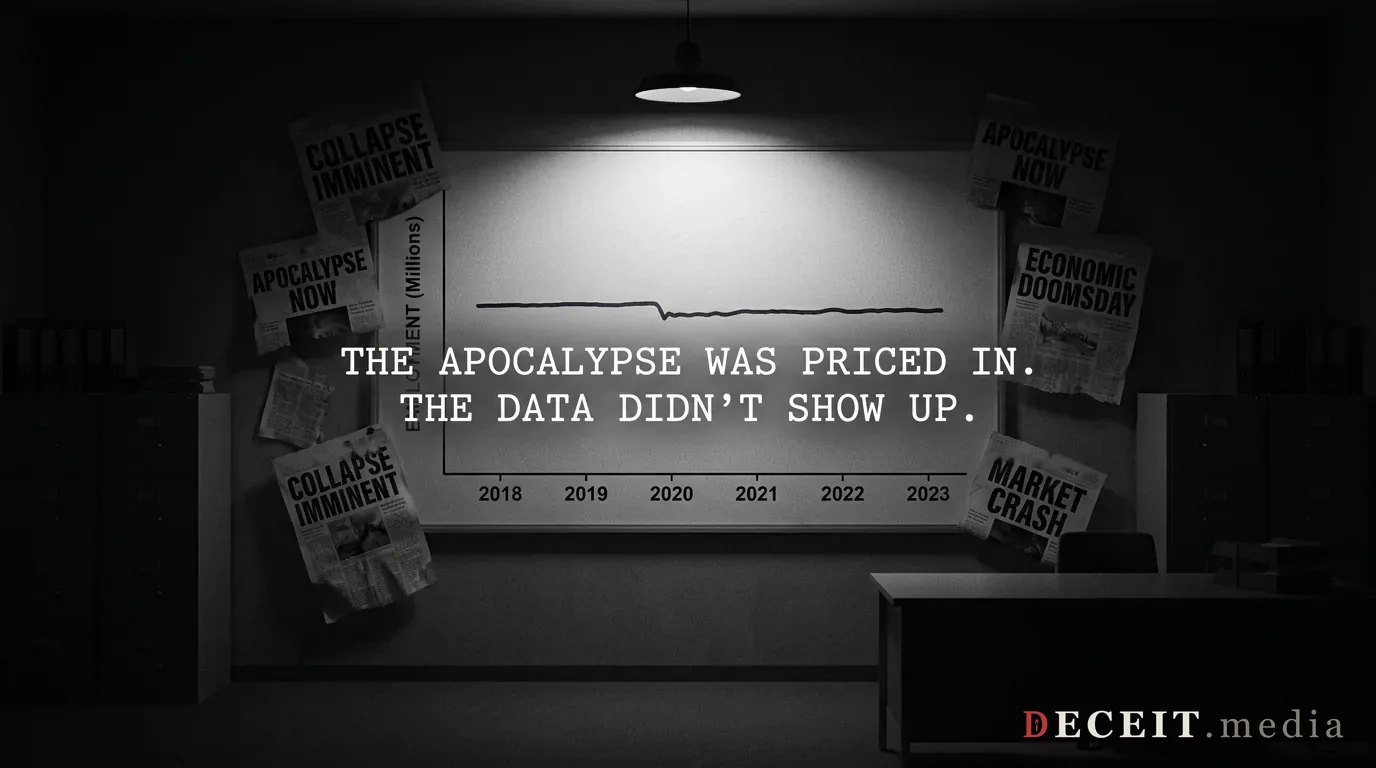
The AI job apocalypse was announced, dated, and priced in. The data did not show up.
What the data actually shows
Tania Babina, an associate professor of finance at the University of Maryland’s Smith School of Business who studies the economic impact of technology innovations, reviewed all the research on AI and employment. Her conclusion: “We don’t have any papers that show systematically that AI is taking jobs.” There is anecdotal evidence, but data across the U.S., Europe, and Brazil does not support the notion that AI is widely disrupting the job market.
A Yale Budget Lab report from October 2025 found: “While anxiety over the effects of AI on today’s labor market is widespread, our data suggests it remains largely speculative. The picture of AI’s impact on the labor market that emerges from our data is one that largely reflects stability, not major disruption at an economy-wide level.”
A study of 12,000 European businesses published in February 2026 found that firms that adopted AI saw a 4% increase in labor productivity, yet did not reduce their staffing in response, at least in the short run. Gizmodo reported that in California, the heartland of tech, “the feared jobpocalypse is nowhere in sight.”
The lump-of-labor fallacy
The “AI will take all the jobs” claim rests on what economists call the lump-of-labor fallacy: the assumption that there is a fixed amount of work to be done, so if AI does more, humans must do less. This is bad economics and worse history. Productivity gains increase demand for labor because labor becomes more valuable. The shape of the labor market changes. Some tasks are automated, some roles are compressed, new roles are created. The aggregate effect has historically been job creation, not destruction.
This does not mean AI has no effect. The Stanford research cited by MIT Technology Review found convincing evidence of a significant effect from AI after 2024, with a 16% decline in entry-level jobs in AI-exposed occupations. But head count grew for senior workers in the same occupations, as did the number of jobs in less exposed occupations. The impact depends on how AI is being used: in jobs where tasks could be automated, employment decreased. In jobs where AI augmented human work, head counts grew faster than average.
The history of wrong predictions
This is not the first time experts have predicted technology would eliminate jobs en masse. In 2016, President Obama’s Council of Economic Advisers warned that automated vehicles could threaten or substantially alter 2.2 to 3.1 million US jobs. Around the same time, AI pioneer Geoffrey Hinton said people should “stop training radiologists now” because it was “completely obvious” that deep learning would outperform radiologists within five years. Neither prediction came true. Truck driving employment remained stable. Radiology training continued. The predictions were confident, specific, and wrong.
Why the fear is the propaganda
The “AI job apocalypse” narrative is propaganda in two directions, but the marketing side is the one with the money. AI companies exaggerate the disruptive potential of their products because it makes the technology seem more powerful than it is, which drives investment, adoption, and valuation. AI critics have their own incentive to exaggerate the harm: it generates clicks, builds audiences, and creates political pressure. The data sits in the middle, ignored by both. The stable, unheadline-worthy data. The data that does not fund anyone.
The real story is less terrifying than either the hype or the doom. AI is changing the labor market. It is not destroying it. Entry-level roles in some occupations are being affected. Economy-wide unemployment is not spiking. The predictions of mass displacement have not materialized. The fear is real. The apocalypse is not.
Verdict: Misleading. The data does not support the claim that AI is eliminating jobs at scale. The prediction was made by people who benefit from the prediction being believed. The evidence, from Yale, Stanford, the University of Maryland, and the European data, says the apocalypse is not here. The hype is.