The Pattern
The Department of Justice’s own press release counted its work in pages: 3.5 million of them, released, it said, “in compliance with the Epstein Files Transparency Act.” A compliance claim is a specific kind of claim. It says: check the record, it holds up. On August 13, a federal judge checked.
What the law requires
The Epstein Files Transparency Act requires the government to release Epstein-related records and to produce a complete log of what it redacted and why. A redaction log is not a formality. It is the difference between “we withheld this to protect a victim” as a policy and “we withheld this to protect a victim” as a claim anyone can verify, line by line, against a reason.
What the judge found
Judge Emmet G. Sullivan reviewed the full documents privately before the hearing. His finding was not that the DOJ redacted too much. It was that the DOJ could not explain what it redacted. Attorney General Todd Blanche had argued that handwritten FBI interview notes did not need release because they were “substantially similar” to a report already published, and that some foreign-language documents could be withheld because “it was not practicable for a first-level reviewer to determine the responsiveness.” Sullivan rejected both as insufficient and ordered the government to document, specifically, how its redactions protect victims, and to supply a complete timeline and log. In February, Rep. Laura Friedman had reviewed files DOJ described as unredacted at its own headquarters and found hundreds of pages still fully blacked out. The compliance claim and the record it describes have now failed to match twice, months apart, in two different ways.
The notes at the center of it
Among the withheld material: handwritten FBI interview notes from a woman who alleged, in that interview, that she met Trump through Epstein in the 1980s and was forced to perform oral sex on him. The DOJ released a report summarizing the interview. It withheld the notes underneath it. Trump has strongly denied the allegation, which remains uncorroborated by any other named source. Whether the allegation is true is not the question this piece answers, and the record does not currently answer it either. The question the court put to the DOJ was narrower and answerable: if the redaction protects a witness, say how; if the notes are duplicative of the published report, as Blanche claimed, show that they are. The government has not yet done either.
What “compliance” was doing
“In compliance with the Epstein Files Transparency Act” is not decoration in a press release headline. It is the specific fact a reader is meant to take from it: the law’s requirements have been met. A judge who reads the same documents the department redacted, rather than the department’s summary of them, is the only check that claim actually has. That check found the account did not hold. The 3.5 million pages are real. The completeness of the compliance they were announced as proof of is what remains unproven.
Verdict: Concealed. The documents released are real, and the page count is not disputed. What is disputed, and what a federal judge found insufficient on direct review, is the DOJ’s own account of why specific material, including notes tied to an allegation against the president, was withheld. A claim of compliance that cannot explain its own redactions when a court asks is not yet a compliant record. It is an unverified one.
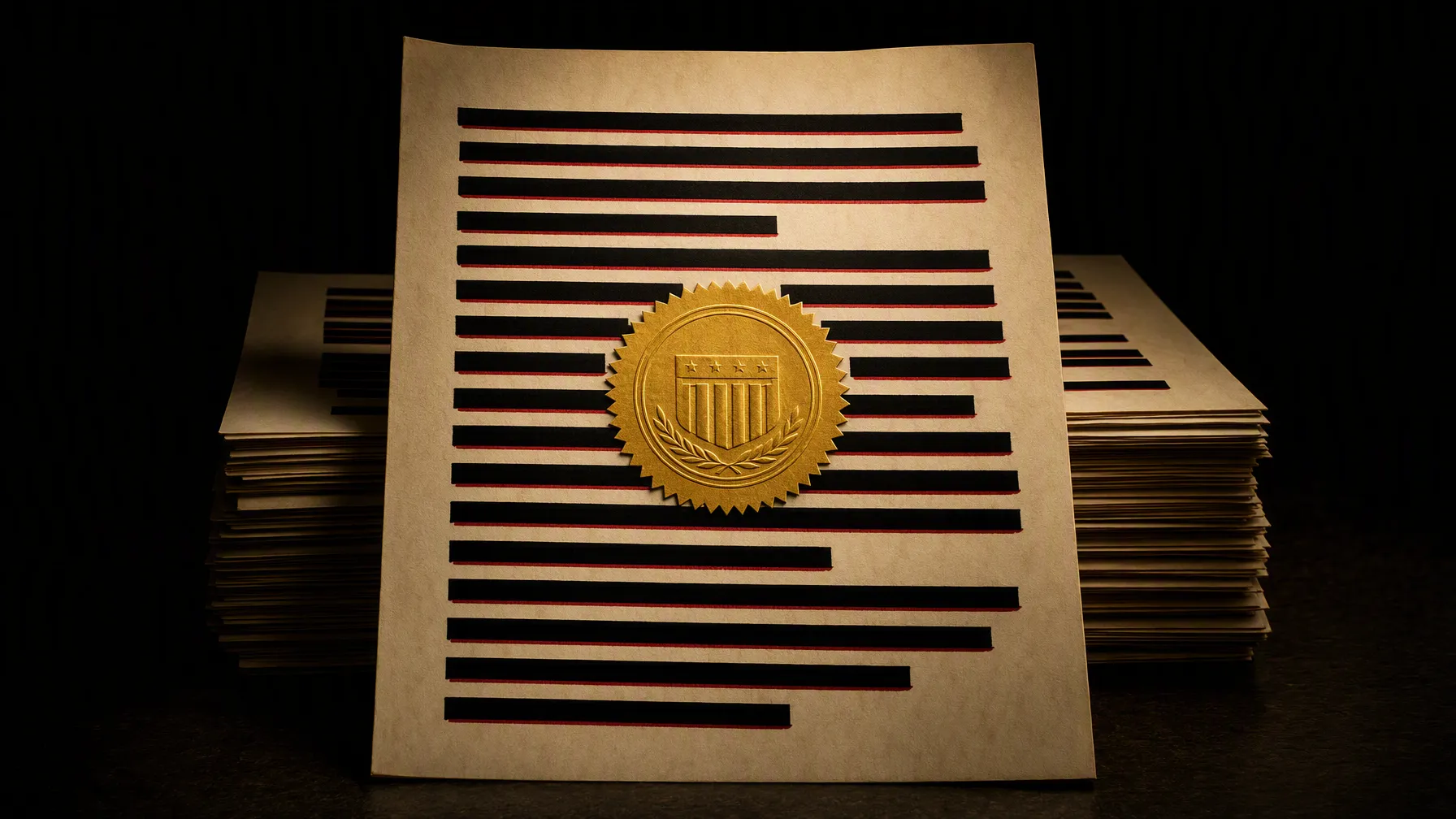
Image note: the scratch-to-reveal illustration above was made by Deceit for this piece. The document and seal are composites; no real document, seal, or person is depicted. Not documentary evidence.