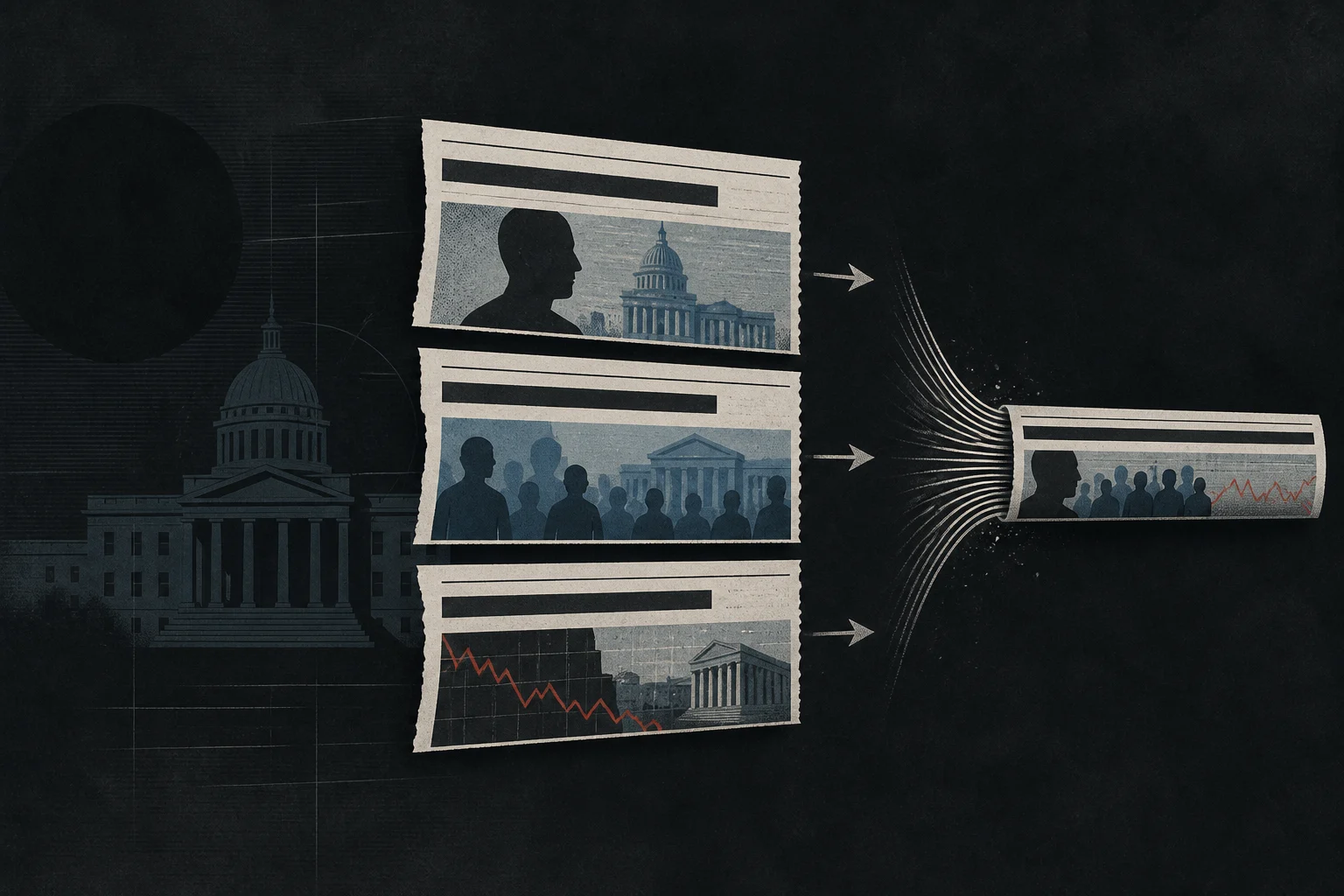
Start with what the suspicious reader is rarely granted: you are right about the core of it. Powerful men in American politics have sexually abused children. Institutions that knew chose not to know. Prosecutors extended courtesies to the connected that no ordinary defendant has ever received. None of that is a theory. All of it is in court records you can read tonight.
So take the premise seriously enough to do what the loudest people shouting it never do, and follow it into the documents. What the documents show is a problem that is real, bipartisan, and protected by the most ordinary machinery imaginable: statutes of limitations, institutional deference, settlements, and prosecutors who go easy on the powerful. What they do not show is a cabal. That distinction is not academic. For a decade the cabal story has been doing specific political work, and that work is easiest to see right now, in a Washington courtroom where the movement that built its identity on exposing elite pedophiles is being threatened with contempt for hiding the files.
First, the impunity you were promised exists
In 2007, Jeffrey Epstein received a non-prosecution agreement from the U.S. Attorney’s Office in Miami. He was under federal investigation over conduct involving roughly three dozen underage girls identified by the FBI at the time. In 2008 he pleaded guilty to two state prostitution-related charges and served 13 months in a county jail with generous work-release. The deal was kept secret from his victims while it was negotiated, as the Miami Herald’s 2018 investigative series documented and as the Justice Department’s own internal review later confirmed. That review, by the department’s Office of Professional Responsibility in 2020, concluded that Alexander Acosta, the U.S. attorney who approved the deal, had exercised poor judgment. It cleared him and his prosecutors of professional misconduct. Acosta had by then already resigned as President Trump’s labor secretary, in July 2019, days after Epstein’s second arrest made the old arrangement national news.
The enablement around Epstein was not occult. It ran through some of the most heavily regulated institutions on earth. JPMorgan Chase paid $290 million in 2023 to settle claims by more than a hundred women that the bank had kept Epstein as a client while ignoring what his accounts were financing, and paid $75 million more to the U.S. Virgin Islands. Deutsche Bank paid $75 million the same year. Bank of America agreed to a $72.5 million settlement in March 2026. The banks admitted no wrongdoing, which is what settlements of this kind are built to avoid, but the sums are their own kind of testimony.
Epstein is not even the clearest case, because Epstein was never a public official. Dennis Hastert was Speaker of the House, second in line to the presidency, the longest-serving Republican speaker in history. In 2016 a federal judge, Thomas Durkin, called him a “serial child molester” from the bench while sentencing him to fifteen months. Not for the boys he abused as a high-school wrestling coach in Illinois, because the statute of limitations had run out decades earlier, but for illegally structuring the bank withdrawals he used to pay $1.7 million in hush money to one of them. The judge noted openly that if the abuse had been prosecuted when it happened, Hastert could have faced decades in prison. Instead the only chargeable crime was the way he moved his own money.
Ten years before that sentencing, the House Ethics Committee had investigated how Congress handled Representative Mark Foley, the Florida Republican who resigned in 2006 after his sexually explicit messages to teenage House pages became public. The committee’s 89-page report found that the speaker’s office and other senior Republicans had likely known about Foley’s conduct toward the pages for months or years, had failed to act, and had in effect chosen not to know. It then found that no member or staffer had violated the House’s code of conduct. The speaker whose office the report described was Dennis Hastert. Foley himself was never criminally charged.
So the suspicious reader’s core claim survives contact with the record. A Speaker of the House abused children and the institution around him absorbed the warnings. A politically connected financier trafficked girls while prosecutors negotiated his impunity and global banks processed the proceeds. Hold on to that. The rest of the record is where it gets complicated.
The record, plainly
No agency keeps an official count of American politicians who sexually abused minors, which is itself worth noticing. But the documented cases are not hard to find, and they do not sort by party.
Anthony Weiner, the Democratic former congressman from New York, pleaded guilty in 2017 to transferring obscene material to a girl he knew was 15, was sentenced to 21 months in federal prison, and registered as a sex offender. Ed Murray, the Democratic mayor of Seattle, resigned in September 2017 after a fifth man, his own younger cousin, publicly accused him of sexual abuse committed decades earlier, when the accusers were teenagers. Murray denied all of the allegations to the end.
Ralph Shortey, a Republican state senator in Oklahoma, was found by police in a motel room with a 17-year-old boy in 2017, while in office. Court filings showed a series of Craigslist ads he had posted seeking encounters with boys, one describing himself as “a married guy looking for a boy” and asking for “the younger the better.” He pleaded guilty to child sex trafficking and was sentenced to fifteen years. Ray Holmberg, a Republican who spent 45 years in the North Dakota Senate and for much of it was one of the most powerful men in the state, pleaded guilty to traveling to Prague with intent to pay for sex with minors. Prosecutors said he had made the trip roughly fourteen times over a decade, patronizing a brothel that offered adolescent boys. In 2025 a federal judge gave the 81-year-old ten years, rejecting a lighter joint recommendation on the grounds that he remained a danger.
The House Ethics Committee concluded in December 2024 that Representative Matt Gaetz, Republican of Florida, had paid tens of thousands of dollars to women for sex or drugs and, the committee said there was substantial evidence for this, had sex with a 17-year-old girl in 2017, which is statutory rape under Florida law. The Justice Department investigated and declined to bring charges in 2023. The committee did not find a violation of the federal sex-trafficking statute. Gaetz has categorically denied ever paying for sex and rejects the report’s findings. All three of those facts belong in the same paragraph, and they stay there.
The pattern extends past elected officials into the operative class on both sides of politics. Anton Lazzaro, a Republican donor and strategist in Minnesota, was convicted in 2023 of sex-trafficking five girls aged 15 and 16 and sentenced to 21 years. George Nader, an informal Trump-world emissary whose name appears more than a hundred times in the Mueller report, was sentenced in 2020 to ten years for transporting a 14-year-old boy into the United States for sex and for possessing child sexual abuse material. Josh Duggar, the reality-television figure who had been executive director of the Family Research Council’s political arm, professionally a face of the “family values” lobby, was convicted in December 2021 of receiving child sexual abuse material and sentenced the following spring to 151 months.
For breadth rather than depth: the Associated Press has cataloged at least 147 state lawmakers in 44 states publicly accused of sexual harassment or misconduct since 2017. Most of those cases involve adults, and an accusation is not a conviction. But the tally gives a sense of the base rate of sexual misconduct in America’s roughly 7,400 state legislative seats, from which the minor-victim cases above are the documented worst.
Put those cases side by side and the shape is not a ring. Shortey was not coordinating with Weiner. Holmberg’s Prague trips had nothing to do with Hastert’s Illinois locker room. What the cases share is not membership in anything. It is access, deference, and time, the same three ingredients documented in every institution that has produced a mass abuse scandal, from dioceses to elite gymnastics. Power does not manufacture abusers at some special rate. It protects the ones it has. It makes colleagues reluctant, victims disbelieved, prosecutors accommodating, and paper trails expensive to follow, until a statute of limitations finishes the job. Every mechanism that shielded these men is boring, legal-adjacent, and visible in the public record. None of it required a cabal. That is the scandal: it never needs one.
One more number belongs here, because it is the one the story’s loudest tellers least want in circulation. In the federal Bureau of Justice Statistics data on sexual assault of children reported to law enforcement, 93 percent of juvenile victims knew their abuser: 59 percent acquaintances, 34 percent family, 7 percent strangers. The overwhelming majority of child sexual abuse in America happens at home, at practice, at church, in the neighborhood. In the trusted middle of ordinary communities, not in the basements of the powerful. The politician cases are real and the elite impunity is real. They are also, statistically, the visible tip of a problem whose center of mass is nowhere near a legislature.
The instrument
Now set the record aside and look at the accusation, because in the last decade “pedophile” has led a second life in American politics, almost entirely disconnected from the cases above.
In December 2016, a North Carolina man named Edgar Welch drove to Comet Ping Pong, a pizzeria in Washington, and fired an AR-15 inside it, because a fabricated online narrative called Pizzagate had convinced him Democratic operatives were holding child sex slaves there. There were no children, no basement, no trafficking. Welch surrendered and was sentenced to four years. Pizzagate’s core move was to read hacked emails as code, name the enemy a pedophile, and skip the evidence stage entirely. That became the template for QAnon, which scaled it into a full cosmology: a cabal of Satan-worshipping elites harvesting children, with one political movement cast as the rescuers.
The costs of that narrative did not fall on elites. In 2020, QAnon adherents flooded the #SaveTheChildren hashtag and anti-trafficking spaces. The Polaris Project, which runs the national human-trafficking hotline, reported contact spikes driven by conspiracy claims that consumed staff time and, as FiveThirtyEight put it in a headline, made it harder to save actual kids. Anti-trafficking organizations spent the pandemic years begging the public to stop “helping.”
Then the accusation migrated from fringe to mainstream vocabulary. After Florida’s Parental Rights in Education law passed in March 2022, researchers at the Center for Countering Digital Hate and the Human Rights Campaign measured a 406 percent surge in tweets calling LGBTQ people groomers or pedophiles. NPR and NBC News traced the smear’s lineage back through Anita Bryant’s 1977 Save Our Children campaign. Child-abuse professionals and survivor advocates told reporters the same thing throughout: diluting “grooming” into a partisan insult makes the term useless for the thing it was coined to detect, and retraumatizes survivors by turning their experience into a slur.
The accusation in this form has three design features. It is aimed exclusively outward, at political enemies such as schoolteachers, librarians and opponents’ donors, and never at the accuser’s own side, which is where at least half the documented cases sit. It is unfalsifiable, because the absence of evidence is recast as proof of the cover-up’s depth. And it is infinitely renewable, because it never has to survive a courtroom. The first two sections above needed no anonymous drops and no decoder ring, just sentencing transcripts and committee reports. The documented version of the problem and the propaganda version point in opposite directions. One says: audit the institutions, extend the statutes, fund the investigators, protect the victims’ names. The other says: hate the people we were already asking you to hate.
Which suggests a test. A movement that sincerely believed its own story, that elites rape children and the government hides it, would treat a locked federal archive about a convicted elite sex offender as the most important object in the world. In 2025, that movement took custody of the archive.
The live experiment
Every entry below is sourced, and the arc speaks for itself.
July 7, 2025. After months of administration figures promising revelations, and after the attorney general, Pam Bondi, had suggested publicly that a client list was sitting on her desk, the Justice Department and FBI released an unsigned two-page memo. It concluded that there was no incriminating client list and no evidence of blackmail of prominent figures, that Epstein died by suicide, and that no further disclosure was warranted. The reversal detonated inside the president’s own coalition. NBC News chronicled the fury among the very influencers who had built audiences on the cabal story.
Mid-July 2025. President Trump dismissed the controversy as a hoax cooked up by Democrats and attacked Republicans who kept pressing as foolish and duped. A Reuters/Ipsos poll taken July 15–16 found 69 percent of Americans believed the government was hiding details about Epstein’s clients. Six percent disagreed.
July 24–25, 2025. Deputy Attorney General Todd Blanche, the president’s former personal defense lawyer, personally interviewed Ghislaine Maxwell, Epstein’s convicted co-conspirator, for about nine hours over two days. Within a week she was transferred from a low-security prison to the minimum-security camp at Bryan, Texas, a placement former Bureau of Prisons officials told NBC News was essentially unheard of for a convicted sex offender. Senator Sheldon Whitehouse formally demanded the transfer paperwork.
November 12, 2025. Democrats on the House Oversight Committee released estate emails including a 2019 exchange in which Epstein wrote to the author Michael Wolff that Trump had known about the girls, and a 2011 note to Maxwell saying Trump had spent hours at his house with one victim. The White House called the release a selective leak designed to smear the president, identified the unnamed victim as Virginia Giuffre, and noted, accurately, that Giuffre had repeatedly said Trump was not involved in any wrongdoing. The emails are claims by a dead trafficker, not findings. The administration fought their release anyway.
November 18–19, 2025. Forced by a discharge petition from Representatives Thomas Massie and Ro Khanna, a device that works only when leadership refuses to allow a vote, the House passed the Epstein Files Transparency Act 427–1. The Senate passed it without objection. The president, reversing himself, signed it. Public Law 119-38 gave the Justice Department 30 days to publish essentially everything, with narrow exceptions for victims’ personal information and active investigations.
December 19, 2025. The statutory deadline passed without compliance.
January 30, 2026. More than a month late, the department published a massive tranche: more than three million pages, roughly two thousand videos, 180,000 images. Its own press release described 3.5 million responsive pages and declared itself in compliance. Survivors’ representatives called the release outrageous within days. Botched redactions had exposed victims’ names and identifying details while the men described as abusing them remained protected, inverting the statute’s one hard privacy mandate.
January–April 2026. The Oversight Committee voted to hold Bill and Hillary Clinton in contempt after they refused to testify, dismissing the subpoenas as legally invalid; both then testified behind closed doors in February. (Testifying, like appearing in Epstein’s contact books, is not an accusation, and that discipline applies to everyone or no one.) British police arrested Andrew Mountbatten-Windsor, stripped of his princely title months earlier, on suspicion of misconduct in public office, after the January release surfaced emails suggesting he had forwarded confidential trade-envoy briefings to Epstein. He was released under investigation. The committee subpoenaed Bondi in March. On April 2, the president fired her and installed Blanche, the lawyer who had interviewed Maxwell, as acting attorney general. NBC News and The Washington Post reported the ouster came amid frustration over her handling of his priorities, the Epstein releases among them.
April–August 2026. The journalist Katie Phang sued the department for failing to comply with the Transparency Act. The case landed before Judge Emmet Sullivan, who ordered production of withheld records and justification for every redaction. Through August hearings, Courthouse News and ABC reported, the government struggled to explain redactions it could not tie to any statutory exception, and handwritten FBI notes remained withheld despite his orders. Congressional Democrats say the public has still seen only a small fraction of what the department holds, with Representative Summer Lee’s office putting it near one percent. That figure is a partisan estimate. It is also undisputed by any government accounting, because the department has produced none. On August 13, Sullivan warned the department’s lawyers in open court that he would hold individuals in contempt if his orders kept being defied, reminding them that he had done exactly that to Justice Department lawyers once before, in the Ted Stevens case.
That is where the experiment stands as of this writing. A law commanding disclosure, passed 427–1 because the base of the president’s own party demanded it. An archive still mostly closed. Victims’ names exposed while abusers’ were protected. The attorney general fired mid-fight. A federal judge threatening contempt. Every actor slow-walking the files belongs to the political tendency whose organizing myth is that elites hide pedophiles.
None of that means the files necessarily incriminate anyone in particular. That is unknowable until they are open, and the one epistemic rule this subject demands is the one the courts attached to the 2024 unsealings: appearing in Epstein’s documents is not evidence of wrongdoing. What the fight reveals is the accusation’s function. When the cabal story was aimed at pizzerias, librarians, and the opposing party, it was promoted from the highest offices in the country. The moment the same story pointed at a real archive in the government’s own custody, one containing real victims and, presumably, real associates of real power, it became a hoax, a distraction, a Democrat trick. The narrative was load-bearing. The archive is load-testing it. The base, to its genuine credit, mostly refused to switch: the 69 percent includes the people who were promised the files, and the 427–1 vote is what it looks like when an audience believes a story more than its authors can afford.
The tell
So: is there a pedophile problem in American politics? Yes, the documented kind. Distributed across both parties and all levels of government, protected by ordinary institutional physics, and dwarfed statistically by the abuse that happens nowhere near politics at all. Is there a cabal? A decade of subpoenas, unsealings, document dumps, and now a disclosure statute has produced convictions of individuals, settlements by banks, and exactly zero evidence of the coordinated satanic network the story requires. Several of the story’s loudest tellers turned out to be on the record themselves.
The test that separates someone fighting child abuse from someone wielding it is short.
The fighter’s concern survives contact with their own side. It names Hastert and Weiner in the same paragraph, because the record does. It wants records: files opened, statutes of limitations extended, mandatory-reporting enforced, court documents unsealed with victims’ names protected, because documents are where real cases live. It follows the 93 percent, putting money and attention where children are actually harmed. And it treats an accusation as the beginning of a process, not the end of one.
The wielder’s concern is a targeting system. It aims only outward. It needs no documents and prefers none, because an opened archive can disappoint. Its proof is the absence of proof. And when it briefly holds the keys to the very vault it spent years demanding be opened, it discovers, suddenly, that there is nothing inside worth seeing, and calls its own believers weak for asking.
The children in the court records were not failed by a shortage of people screaming about pedophiles. Hastert’s wrestlers. The girls in Lazzaro’s condo. The boy in the Oklahoma motel room. The boys in Prague. The three dozen girls the FBI counted in Palm Beach in 2007. Several were failed while the screaming was at its loudest. They were failed by institutions that preferred not to know and by prosecutors who extended courtesy to power. Both of those failures have remedies, and neither remedy is a narrative. Open the files. Protect the victims’ names. Extend the statutes. And keep a permanent, public grip on the difference between an accusation that ends in a courtroom and one that is designed never to arrive at one.