The Pattern
Politicians have not spoken at the September 11 ceremony at the World Trade Center since the practice was ended in 2012. The National September 11 Memorial and Museum told CBS New York that politicians “do not deliver remarks and are asked to remain in a designated area.” Family members read the names. The September 11, 2026 commemoration was scheduled as a private ceremony with a public livestream.
The dispute in the weeks before the ceremony was over whether the sitting mayor of New York may stand silently, in an assigned spot, at a burial ground.
Mamdani attended the commemoration on September 11. Reuters photographed him there.
How the claims changed
Each change can be checked against a dated record from before the ceremony.
A kinship term becomes a fabrication charge
The speech was an answer to something. Days earlier, a radio host had suggested on air that Mamdani would cheer another September 11. Andrew Cuomo, his opponent, was on the line. Cuomo’s reply was “that’s another problem.”
On October 24, 2025, outside the Islamic Cultural Center of the Bronx, Mamdani responded. One line: “I want to speak to the memory of my aunt, who stopped taking the subway after September 11th because she did not feel safe in her hijab.”
It was not the speech’s only example, or its central one. In the same passage he described a staff member who had the word “terrorist” spray-painted on their garage, a mosque set on fire, and a classmate pressed to become an informant. He drew a line between those and his own comparatively light experience: “I have never had the word ‘terrorist’ spray-painted on my garage, as one of my staff had to endure. My mosque has never been set on fire.”
Online, the aunt line was lifted out of that sequence and treated as a discrete factual claim. Critics noted that Mamdani’s only biological aunt, Dr. Masuma Mamdani, had a LinkedIn profile showing work in Tanzania from 2000 to 2003. Mamdani clarified that he had meant his father’s late cousin, whom he called “Zehra fuhi.” CNN reported his clarification on October 28.
His clarification identified a different relative from the one critics had looked up. It was reported by the Washington Examiner and the Washington Times as an admission of inaccuracy. The thing tested was the word for the relative. The claim underneath, that Muslim women changed how they moved around New York after 2001 because they were afraid, went untouched.
The hedge inside the joke
The next day, October 25, 2025, the Vice President posted: “According to Zohran, the real victim of 9/11 was his auntie who got some (allegedly) bad looks.”
Note what the parenthesis does. “Allegedly” is a hedge attached to a detail nobody had disputed and nobody could check either way. It converts an unverifiable private memory into an open question while the sentence moves on. The reader is left holding a doubt that was never argued for.
Then there is scale. A woman afraid on a train is not a competing claim to the 2,977 people who were killed. Putting the two in one sentence, with “real victim” between them, invents a contest that nobody had entered.
Mamdani’s reply, to ABC News two days later: “It is sadly unsurprising, but still shocking to see the vice president of this country try and make a cheap joke about Islamophobia when what New Yorkers want is a vision of a city that can come together.”
A religious test loses its adjective
In a September 6, 2026 Newsmax interview, Rudy Giuliani said the following, as quoted by The Hill:
“Frankly, whatever he’d like to say, he doesn’t agree that Sept. 11 was an Islamic terrorist attack on the United States of America.”
By the next day, that sentence was in circulation in a shorter form. ABC7’s own summary rendered it as Giuliani “suggesting the mayor does not believe the Sept. 11 attacks were acts of terrorism.” The station presented this as its characterization, not as a quotation, and noted that critics called Giuliani’s claims baseless.
One word did not survive the trip. “Islamic” was carrying the sentence. The claim was not that Mamdani denies the attacks were terrorism. It was that Mamdani will not call them Islamic terrorism, which makes the mayor’s religion the thing being measured. Remove the adjective and you get a wilder-sounding accusation that is also easier to wave off, and the test disappears from view.
The opening clause does its own work. “Whatever he’d like to say” settles in advance that Mamdani’s own statements will not count. This matters because they contradict the claim. In a statement in July, quoted by The Hill, Mamdani called the attacks “that horrific terror attack.” Speaking to ABC7 on Sunday he called them “the horrific act of terror of September 11th.” The clause was built to hold either way.
The Guardian also reported that Giuliani accused Muslims generally of wanting to dominate the United States and described Mamdani as a supporter of that alleged goal.
Giuliani moved from an allegation about an entire religion to a claim about one person. Nothing between them establishes anything about the man. The group-level claim is doing the work, and the individual is being read off it.
Named officials responded on the record. Governor Kathy Hochul called the remarks “wildly inappropriate,” saying “this is a moment in our time we should be united as a people.” Attorney General Letitia James said of Mamdani: “He represents the city of New York and he will be there on 9/11 and so will I.”
What the petition can tell us
CBS New York reported that Giovanni Galante started the petition with another person who lost a spouse on September 11. His wife, Grace Catherine Galante, worked on the 105th floor of the north tower and was killed in the attack.
It is also an open petition on Change.org. The public signature count does not tell us how many signers lost someone in the attacks.
The test
The demand for a particular description of the attacks set up a test of belonging.
Mamdani is asked to describe the attacks in a particular vocabulary. He describes them, twice, in the strongest terms available. The description is ruled inadmissible in advance. A claim about Muslims generally is then offered as the reason, and he is placed inside it.
There is no answer available that passes. A test with no passing answer is not measuring anything about the person taking it.
What the argument buried
Mamdani said a Muslim woman stopped riding the subway because she was afraid. The FBI counted 28 anti-Muslim hate crimes in 2000. In 2001 it counted 481. Reviewing twenty-five years of that series in September 2026, the Pew Research Center reported that the number “has never returned to pre-9/11 levels.”
The federal figures document the rise in anti-Muslim hate crimes. The subway account describes how that climate felt to one family.
The damage did not stop in 2002. In Pew’s survey published on September 3, 59 percent of American Muslims said they had experienced discrimination in the past year. In 2007 it was 40 percent. In 2017, 48. Pew found that Muslims who are visibly identifiable, “including women wearing headscarves,” were especially likely to say so. The Council on American-Islamic Relations logged 8,683 complaints in 2025, more than in any year since its first report covering 1996. The FBI’s 2024 count is 228 anti-Muslim hate crimes. Muslims are now the second most targeted religious group in the country.
The belief underneath is not confined to the person who said it. In a separate Pew survey of American adults conducted in May, and cited in the same report, 43 percent said Muslims are “less patriotic than other Americans.” Fifty-one percent said Islam “encourages violence more than other religions.”
The families
Giovanni Galante does not want the anniversary of his wife’s death turned into an argument. Monica Iken Murphy, whose husband Michael was killed in the south tower, told CBS New York she wants “a little time for ourselves.” Nothing above is addressed to them. Grief does not have to be reasonable, and a person who says the day already costs them enough is not running a campaign.
The families are not of one mind about it. September 11th Families for Peaceful Tomorrows, on July 28, said it “firmly supports the presence at Ground Zero of anyone who comes to pay their respects,” condemned “the anti-American accusations and Islamophobic sentiment underlying the effort,” and restated a position it has held for decades: “Ground Zero is sacred space and should never be used as a platform for political speech or partisan politics. Ground Zero remains a burial ground.”
One more number
ABC7 reported on September 7 that nearly every New York City mayor before Mamdani has attended. That is true and it is smaller than it sounds.
The annual ceremony dates from the first anniversary in 2002. Giuliani’s term as mayor ended on December 31, 2001, so he has never been the sitting mayor at one. The mayors who have are Bloomberg, de Blasio and Adams. Three men, across twenty-four ceremonies.
What this is
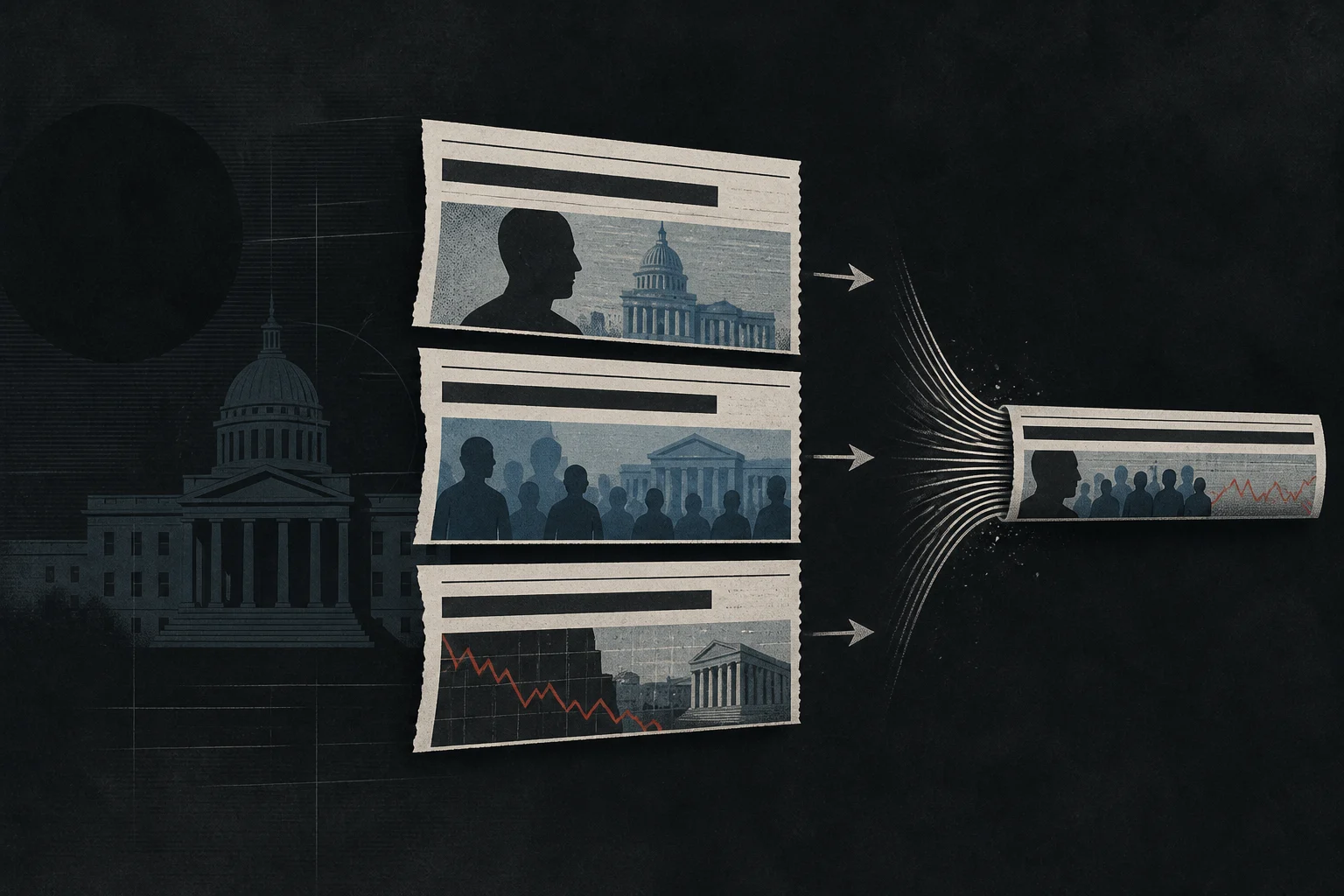
Over ten and a half months, a story about fear on the subway became an argument over who could stand at Ground Zero.
No step in the sequence required a false statement. A hedge inside a parenthesis and a clause that discounts the answer before it arrives are not errors a correction can reach. Mamdani clarified whom he meant. Months later, the argument had shifted to whether his own description of the attacks should count.
The record leading up to the ceremony spans ten and a half months.
In 2001 there were no Muslims in Congress. Pew counts four now, with a fifth arriving, and a Muslim mayor of New York. The argument that September was over whether the last of them may stand in a designated area, in silence, at a ceremony where nobody speaks.