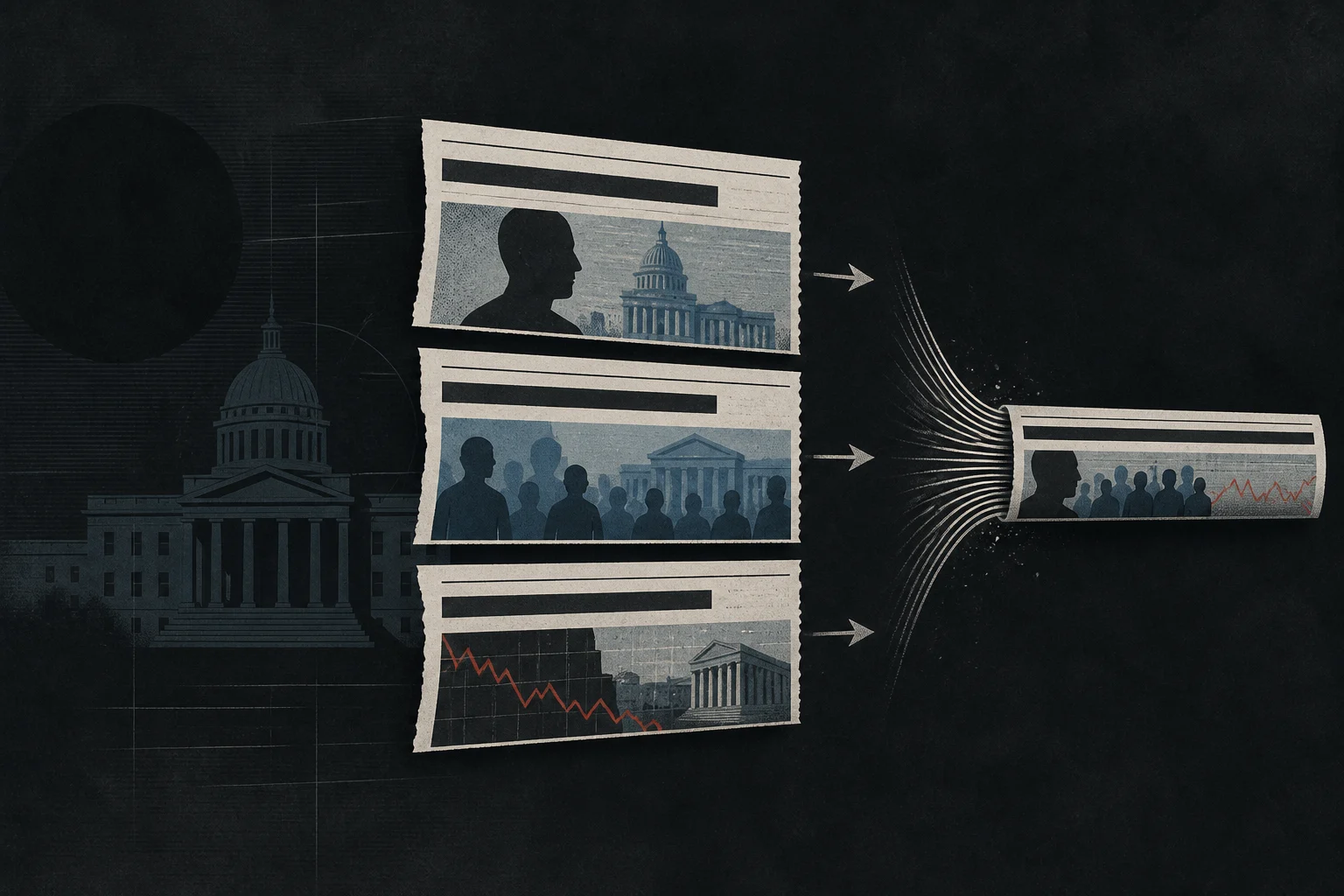

The Pattern
The post says: “Every single Muslim holding public office in America is a trojan horse, and a threat to both national security and our republic. We refuse to be silent.” It went up on X on August 7, 2026, from the verified account of Nancy Mace, a sitting member of the U.S. House of Representatives. Within days it had 10.8 million views, over 100,000 likes, and tens of thousands of reposts and replies.
The post never names an official, an act, or an incident. That omission is the whole claim.
What “every single Muslim” actually means
Four Muslim Americans currently serve in Congress: Rashida Tlaib (D-MI), Ilhan Omar (D-MN), André Carson (D-IN), and Lateefah Simon (D-CA). None was accused in Mace’s post, or anywhere since, of a specific act against national security. None needed to be. The claim isn’t about conduct. It’s about category: every Muslim who holds or seeks public office, an indefinite set that, as of two days earlier, also included a Michigan doctor who had just won a Senate primary and hadn’t been sworn into anything yet.
Tlaib and Omar were each re-elected to their current terms in 2024 with landslide margins, 70 percent and better than 75 percent of the vote respectively, by the same electorates Mace says are being infiltrated. Carson has held his Indianapolis seat since 2008. A trojan horse, in the myth, is a threat because no one can see what’s inside it. These four have spent between two and eighteen years in full public view, voting on the record, running for re-election, and winning.
This is not the first time
Mace has run this exact claim before. In a fundraising email dated November 6, 2025, she told supporters that New York City Mayor-elect Zohran Mamdani “is bringing SHARIA LAW to America.” PolitiFact rated it Pants on Fire, its lowest rating. The fact-checkers found no evidence Mamdani had ever proposed replacing New York law with religious law; his actual positions on LGBTQ rights and sex-work decriminalization are, in one expert’s words cited in the fact-check, close to the opposite of Sharia governance. No one can impose religious law on anyone in the United States regardless. The First Amendment already forecloses it. PolitiFact’s own writeup called the claim a rerun of birtherism-era talking points. It raised money anyway. Nine months later, the sequel had a new lead.
The timing
Mace posted the trojan horse claim two months and change after her own campaign collapsed. On June 9, 2026, she finished fifth and last in South Carolina’s Republican gubernatorial primary, taking 12.2 percent of the vote after Donald Trump declined to endorse her, a snub she blamed on her support for releasing the Epstein files. She conceded and endorsed Alan Wilson, the second-place finisher, in the runoff, dropping out of the news cycle she’d spent years cultivating.
Two days before the trojan horse post, on August 5, Abdul El-Sayed, a doctor born in Rochester Hills, Michigan, and the son of Egyptian immigrants, won Michigan’s Democratic Senate primary by roughly a single point, after outlasting more than $60 million in opposition spending, most of it from pro-Israel groups, including upwards of $30 million from AIPAC itself. Coverage called it a body blow to the country’s most powerful pro-Israel lobbying operation. It was also, not incidentally, the biggest national story available for a stalled political career to attach itself to.
The clip that wasn’t the story
El-Sayed’s victory speech included one word that became the story instead of the win: “inshallah,” meaning God willing, used the way most Arabic speakers use it constantly, religious or not, roughly the way an English speaker says “hopefully.” Stripped of the sentence around it, the word was recast across the right side of X as evidence of a religious takeover.
Al Jazeera’s investigation into the spread mapped 1,966 accounts and more than 2,500 connections forming within 24 hours, and found the pattern wasn’t organic. It was centralized around a handful of accounts (Benny Johnson, Laura Loomer, “End Wokeness,” “ALX”) that established the framing before secondary accounts expanded it outward. Ted Cruz amplified it. Trump attacked El-Sayed directly. Mace’s post landed inside that same 48-hour window, using the same vocabulary her allies were already circulating: threat, invasion, trojan horse. A pile-on that looks spontaneous from inside any single account looks engineered from above it.
She didn’t walk it back
Mace didn’t walk it back. Two days later, replying to Rep. Pramila Jayapal, she wrote: “She’s right. I don’t want to get stabbed or blown up by a suicide bomber - nor do I want to hear the call to prayer five times a day in the United States of America. Total Islamophobe here.” On CNN that same weekend, she told anchor Omar Jimenez: “in the future, when our granddaughters are wearing burkas to school, we’re going to look back and say, how did this happen?” Separately, she tried to tie both El-Sayed and New York Mayor Zohran Mamdani to terrorism by association. It’s the same guilt-by-association playbook this outlet has already catalogued in Mamdani’s case: a real fact, an unrelated fact, and a caption asking the reader not to notice the gap between them.
Jimenez asked her directly: was she saying any Muslim person is a threat to the country. Mace narrowed it to “elected officials,” which is the claim she’d already made, just restated as though it were a concession. Jimenez read her the First Amendment. He read her Article VI, which bars any religious test for holding office in the United States. Still, Mace’s closing line was the one that mattered: “Go back to that country is all I have to say. Go back to that country of origin.”
Tlaib’s country of origin is Detroit. El-Sayed’s is Rochester Hills, Michigan (forty minutes up the road, if you’re keeping track). Omar’s actual country of origin, Somalia, is one she fled as a child refugee and hasn’t held citizenship in for more than two decades. There is no country to send any of them back to that isn’t the one Mace represents in Congress. That line is the tell: underneath the national-security language is a claim about who gets to belong here, not about what anyone did.
The record the post erases
No hearing, indictment, whistleblower complaint, or intelligence assessment names a sitting Muslim official as a security threat. What the government’s own recent record shows instead: the Director of National Intelligence, Tulsi Gabbard, falsely claimed at a December 2025 Turning Point USA event that Paterson, New Jersey, and Houston, Texas, were examples of Sharia law expanding in America. Paterson’s own mayor called the claim false, and a U.S. senator called it dishonest. Reps. Keith Self and Chip Roy’s Sharia-Free America Caucus, launched that same month, had grown to 68 members from 25 states within half a year. Four separate federal bills are currently moving through Congress to ban a legal system no U.S. jurisdiction has ever adopted: the No Sharia Act, two versions of the Preserving a Sharia-Free America Act, and the Defeat Sharia Law in America Act. None of these bills identifies a place where Sharia governs anyone. None needs to. The bill is the claim; the claim doesn’t need a location.
None of this is new, either. The “trojan horse” framing is part of the same two-decade pattern that began with a training-camp myth, one that produced zero evidence and two real bomb plots long before this news cycle. This outlet mapped that history separately.
Meanwhile the Council on American-Islamic Relations logged 8,683 discrimination complaints in 2025, the highest single-year total since it started counting in 1996 and fractionally above the record set the year before. Employment discrimination topped the list at 1,101 cases. Minnesota’s complaints rose 96 percent year over year; Chicago’s rose 65 percent. Thirty-three separate incidents targeting mosques and Islamic institutions were logged in a single year. Nobody has produced a comparable ledger running the other direction: a documented tally of national-security harm caused by a sitting Muslim official. The threat in the trojan horse is imaginary. The 8,683 complaints are not.
What the replies already said
Two responses under Mace’s own post did in one line what this piece has done in a thousand words. An account posting as Melissa Wong reposted the exact sentence with one word changed: “Every single Zionist holding public office in America is a trojan horse, and a threat to both national security and our republic.” A second reply, from an account posting as Adnanimus, asked the plainer version of the same question: “Imagine if a U.S. politician posted this same message and wrote ‘Jew’ instead.”
Neither reply needed a citation. Swapping the protected category and reading the sentence back is the whole test, and the sentence fails it in about four seconds.
How to check this yourself
- Ask what specific act is being described. “Threat” is an adjective. A threat assessment names a person, a plan, or an incident. This post named a religion.
- Run the substitution test. Replace the named group with a different protected class (a different religion, a nationality, a race) and read the sentence again. If it only survives against one group, it was never a security claim.
- Check who’s actually served, and for how long. Four Muslim members of Congress have a combined decades of public voting records. A hidden threat that votes on C-SPAN for eighteen years isn’t hidden.
- Look for the incentive, not just the inflammatory line. A career in freefall two months earlier is a reason to manufacture an outrage cycle. It is not evidence for the claim inside it.
- Check whether this is a rerun. A claim that already earned a fact-checker’s lowest rating once doesn’t get more true by changing the name in the sentence.
- Trace whether the pile-on is organic. A claim that a small, mapped cluster of accounts pushed into wide circulation within 24 hours is a campaign, not a consensus.
- Watch for the citizenship tell. “Go back to your country” only makes sense once the speaker has stopped making a security argument and started making a belonging argument. Listen for the moment the claim changes shape.
- Compare the ledgers. One side of this story has a number: 8,683 documented complaints in a single year. Ask what number the other side has, and notice if nobody can produce one.
A congresswoman two months removed from finishing last in her own primary needed a national story, and Michigan handed her one two days early. She didn’t need evidence, because the post was never a security assessment. It was a costume for an older claim: that an entire religion doesn’t belong in the government some of its own members were elected to run. The people who paid for it are the 8,683 who filed a complaint this year, and the four members of Congress now being asked, on live television, to justify their citizenship.